SMT Solder Paste Manufacturers.

Focused on SMT soldering processes, a one-stop electronic soldering solutions provider.

Here you can find knowledge about Soldering Material, including but not limited to usage methods, installation techniques, troubleshooting and more. Focused on SMT soldering processes. If you can't find what you need, please contact us anytime.
This paper focuses on the practical application of sensor solders in the SMT process of electronic sensor PCBs, covering the solder selection logic for common sensors such as thermal sensors, pressure sensors, and acceleration sensors, key points for reflow profile adaptation, and production line-level troubleshooting paths for cold solder joints and missed solder joints. It emphasizes the differentiated performance of two sensor solders, Jiajinyuan SN100C and SN63Pb37, in terms of wettability, residue activity, and thermal shock resistance.
Published: 2020-05-08To address common issues such as cold soldering, poor wetting, and solder beads that frequently occur in the high-volume production of consumer electronics motherboards with OSP boards, this solution is based on measured production line data from Jia Jinyuan, focusing on four key measures: stencil aperture optimization, dynamic nitrogen concentration control, reflow oven temperature zone gradient matching, and AOI false alarm rate reduction. It stably improves the first-pass yield of OSP board soldering to 99.23%, with a single-line daily output exceeding 8500 units.
Published: 2020-02-17
Whether flux paste must be cleaned after SMT soldering depends on the chemical activity and ion content of the flux residue, as well as the requirements of subsequent assembly processes. No-clean flux paste is not completely residue-free; rather, its flux residue becomes inert and low-corrosive after reflow. However, high-density BGA or aerospace-grade products still require cleaning to mitigate the risk of long-term electrochemical migration.
Published: 2019-12-31The head-in-pillow effect caused by solder paste defects and X-ray void defects in BGA soldering require coordinated troubleshooting from four aspects: solder paste selection, stencil design, printing parameters, and reflow profile. Insufficient wetting, uneven flux volatilization, or pad oxidation during the solder paste soldering process will exacerbate solder paste defect manifestations. Combining X-Ray image features can quickly identify the root cause of voids.
Published: 2019-12-14Solder auxiliary materials are indispensable supporting consumables in the PCBA soldering process, among which flux and PCB cleaning solvent directly affect soldering wettability, residue control and subsequent reliability. The Jiajinyuan series flux is compatible with 0201 to QFN0.4mm pads in SMT reflow soldering and wave soldering scenarios. Its rosin-based active ingredients take effect at 150℃ and complete activation at 235℃. When used with Jiajinyuan halogen-free PCB cleaning solvent, the ROSE method ion contamination value can be achieved <0.78μg/cm2.
Published: 2019-12-02
Flux paste residues do carry a risk of moisture absorption after long-term storage, which can significantly reduce the insulation reliability of PCBs, especially in high-humidity environments. In actual production lines, leakage failures between adjacent pads caused by moisture absorption of uncleaned rosin-based flux paste have occurred multiple times, and this problem is particularly prominent in enclosed areas such as under BGA and fine-pitch QFN.
Published: 2019-11-08When the fine line spacing in FPC soldering is less than 0.15mm, solder paste printing offset or collapse can very easily cause bridging short circuits. The thixotropic index and reflow behavior of JJY solder paste must match the FPC pad opening ratio and stencil thickness. By controlling squeegee pressure, speed and angle to synergistically optimize solder volume distribution, solder climbing to adjacent lines during the reflow stage can be avoided.
Published: 2019-10-18
Excessive volatilization of solder paste during high-temperature soldering can lead to typical defects such as solder balls, cold solder joints, and bridging. This is especially likely to induce splattering and poor wetting in a nitrogen atmosphere or during reflow soldering with a high heating rate, directly affecting the SMT first-pass yield and long-term reliability.
Published: 2019-09-23Through on-site testing of Jiajinyuan domestic solder on the SMT production line under combinations of different temperature zone profiles, stencil apertures, and squeegee pressure settings, the soldering performance on circuit boards was evaluated. It was found that the difference in wettability and void rate between this domestic solder and imported materials is less than 8%. After optimizing solder paste storage temperature control and fine-tuning the nitrogen purity of the reflow oven, the first-pass yield of PCBA increased from 92.3% to 96.7%, significantly reducing circuit board soldering defects such as cold solder joints, tombstoning, and bridging.
Published: 2019-08-26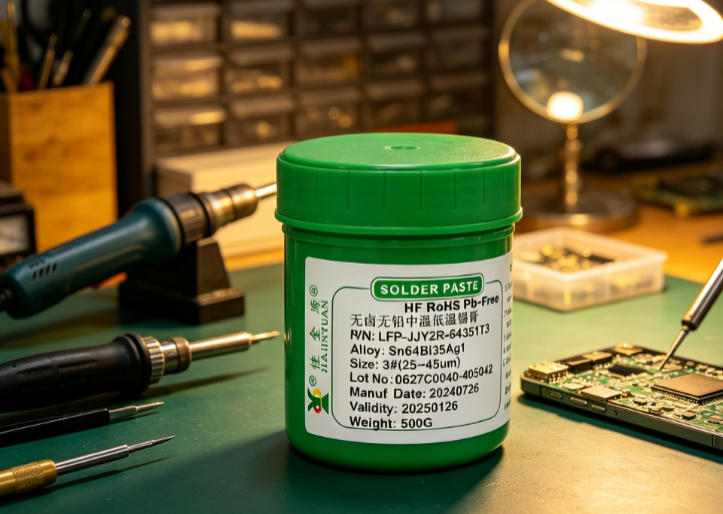
Purchasing solder paste, solder wire, and solder bars must be closely tied to the actual production line performance when screening suppliers, with a focus on batch stability, consistency between measured metal content values and J-STD-005, and whether the solder paste thixotropic index is suitable for high-speed printing machines. At the same time, the tensile strength of solder wire and the corrosivity of flux paste residues must be verified to avoid solder bridging, cold solder joints, or poor cleaning caused by material fluctuations.
Published: 2019-07-02Our technical team is always ready to provide professional solder material selection advice and SMT process solutions.