SMT Solder Paste Manufacturers.

Focused on SMT soldering processes, a one-stop electronic soldering solutions provider.

Here you can find knowledge about QFN Solder Paste, including but not limited to usage methods, installation techniques, troubleshooting and more. Focused on SMT soldering processes. If you can't find what you need, please contact us anytime.
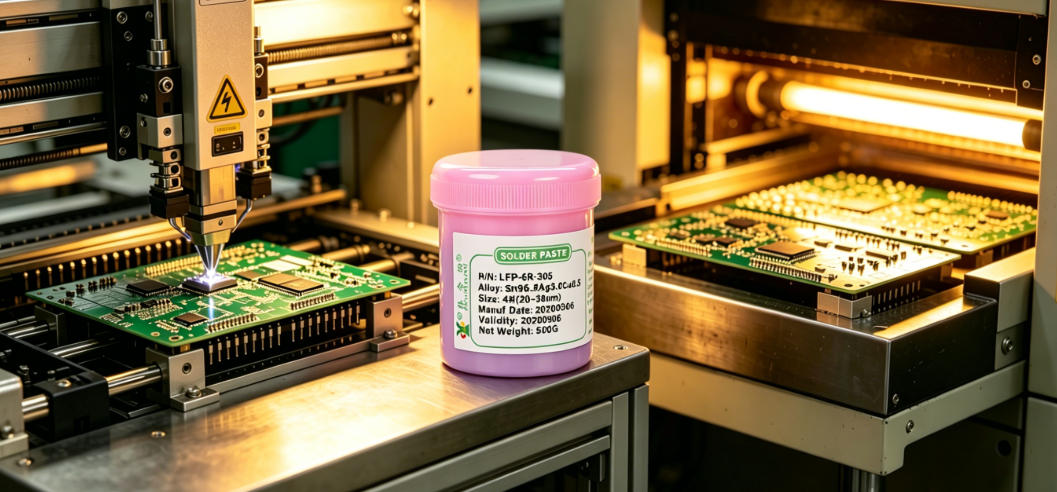
QFN soldering places extremely high demands on the activity, particle size distribution and metal content of solder paste. It is recommended to use Type 4 or Type 5 rosin-based no-clean solder paste with a metal content of 90.5±0.3%. In actual production lines, improper solder paste selection or mismatched printing parameters can easily lead to typical defects such as solder bridging, open soldering, tombstoning and bottom bridging.
Published: 2026-07-10Internal voids in BGA/QFN solder joints will significantly weaken electrical and thermal conductivity. Especially when the void area ratio exceeds 25%, the thermal resistance of the solder joint rises by more than 30%, and the current carrying capacity decreases significantly. When X-ray inspection in the production line finds that voids are concentrated in the center of the pad or the edge area of the chip, it is necessary to immediately investigate key factors such as solder paste printing offset, excessive oxygen content in the reflow atmosphere, and oxidation of the PCB pad.
Published: 2025-12-06As fine-pitch QFN pin spacing shrinks, the risk of bridging is further aggravated. Anti-slump and anti-tailing performance must be achieved by regulating the rheological properties of solder paste. JF-608 solder paste from Jiajinyuan demonstrates excellent viscosity retention under 217°C reflow conditions. When paired with 0.12mm stencil aperture and a 35° squeegee angle, it can stably control the bridging rate within 80ppm.
Published: 2025-11-11
Jiajinyuan LFP series halogen-free solder paste has completed QFN packaging process verification, with the measured solder wetting rate close to 100%, significantly improving solder joint wettability and bridging control capability. Relying on 0307/T4 alloy powder and ROL1 grade low-halogen formula, it maintains high activity while meeting IPC-J-STD-00
Published: 2023-10-25QFN soldering on new energy electronic control boards faces dual challenges of high-frequency vibration and thermal cycling. By optimizing stencil aperture design, reflow profile, and pad design, Jiajinyuan has increased the thrust of QFN solder joints to over 28N, with the IMC layer thickness controlled at 3.2μm±0.4μm, effectively suppressing microcrack propagation and meeting the long-term reliability requirements of automotive-grade IPX7 protection and operating conditions ranging from -40℃ to 125℃.
Published: 2022-12-11Nitrogen reflow in BGA/QFN precision soldering suppresses oxidation, improves wettability, and optimizes the flowability of molten metal, stably reducing the void rate from 18%~25% under air reflow to 4.2%~6.8%. The measured purity of the Jiajinyuan nitrogen generator reaches 99.999%, with a dew point ≤ -60℃. Combined with precise flow control (15~25L/min) and real-time monitoring of furnace oxygen concentration (≤100ppm), it can directly reuse existing reflow oven hardware to complete production line upgrades.
Published: 2022-09-19X-Ray inspection can penetrate PCBs and packages to directly observe void ratios, bridging, cold solder joints, and offset conditions at the bottom of devices such as BGAs and QFNs, avoiding missed judgments in blind spots that cannot be covered by traditional AOI and ICT. It is the most reliable non-destructive method for verifying reflow soldering quality in SMT processes.
Published: 2022-03-16Poor wetting of the bottom pad during QFN soldering often leads to cold solder joints or voids. By changing the stencil aperture from the conventional 1:1 to a 0.92:1 trapezoidal scaling design, JJY significantly improves the solder paste transfer rate without increasing the amount of solder. Combined with the coordinated control of squeegee pressure at 0.45 MPa and speed at 45 mm/s, the wetting area of the QFN soldering bottom pad is increased from 68% to 91%, and the measured solder joint void rate is below 12%.
Published: 2021-09-26When reflow soldering precision BGA/QFN devices, the heating rate directly affects solder joint void ratio, solder ball collapse consistency, and PCB warpage risk. In particular, a preheat ramp exceeding 3℃/s can easily cause ceramic substrate cracking, while insufficient flux residue control occurs when the soak stage duration below 150℃ is less than 90 seconds. Jia Jinyuan's measured data shows that the void ratio of QFN bottom solder joints increases by 27% as the heating slope rises by 1.2℃/s. The temperature difference across the entire board must be controlled within ±2.5℃ to ensure first-pass yield.
Published: 2021-03-25Excessive solder paste voiding rate of the thermal pad at the bottom of QFN is a high-frequency failure on SMT production lines, requiring coordinated optimization from four aspects: solder paste selection, stencil aperture design, printing parameters, and reflow profile. Although low-void solder paste can reduce the voiding rate, it cannot replace process matching. The squeegee pressure and speed, nitrogen purity, and temperature gradient of each reflow zone must be adjusted in accordance with the actual equipment status of the production line.
Published: 2016-03-21Our technical team is always ready to provide professional solder material selection advice and SMT process solutions.