SMT Solder Paste Manufacturers.

Focused on SMT soldering processes, a one-stop electronic soldering solutions provider.

Here you can find knowledge about Low-Temperature Solder Paste, including but not limited to usage methods, installation techniques, troubleshooting and more. Focused on SMT soldering processes. If you can't find what you need, please contact us anytime.
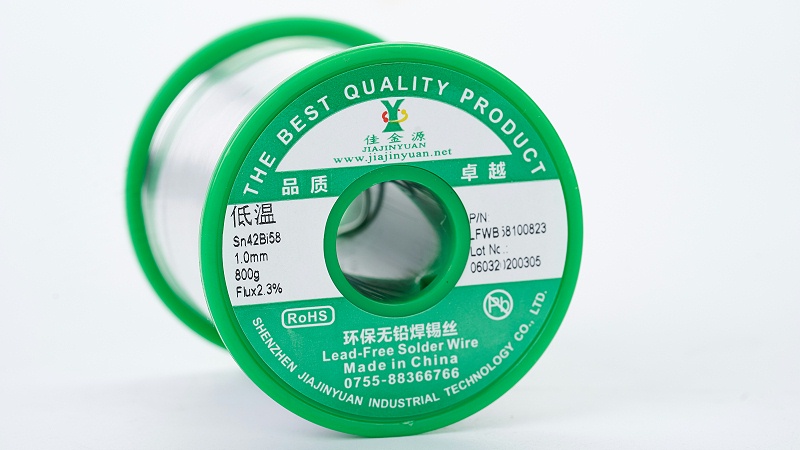
What everyone usesSolder wireIn the product, the tin content of the solder wire is15%and99%Between,
Published: 2026-05-12
Low-temperature solder wire is suitable for soldering heat-sensitive components such as MLCCs, tantalum capacitors, LED beads, CMOS image sensors, and flexible FPCs. Its 138℃ melting point significantly reduces the risk of thermal shock. Combined with the moderately active rosin core and low residue, it balances wettability and component reliability in both SMT reflow and manual touch-up soldering.
Published: 2026-01-08
Low-temperature solder paste is suitable for heat-sensitive components such as MLCCs, LED beads, flexible printed circuits, and connectors with plastic housings. Its melting point is typically 138°C to 170°C, more than 50°C lower than that of traditional solder paste, which can significantly reduce the risk of thermal stress damage, while imposing higher requirements for reflow soldering zone settings and nitrogen protection.
Published: 2025-08-20In the ball mounting process, adopting a low-temperature solder paste solution can significantly reduce the thermal stress on BGA chip bodies, avoiding common production line failures such as pad peeling, silicon die microcracks, and molding compound delamination. In actual tests of the Jiajinyuan LTS series solder paste, this solution achieved ball diameter consistency of ±0.02mm at a peak temperature of 185℃, while balancing wetting and spreading performance with residue insulation properties.
Published: 2024-01-28During FPC soldering, using low-temperature solder paste and solder wire can significantly reduce the thermal stress on the substrate, avoiding thermal damage phenomena such as coverlay wrinkling, copper foil peeling, and PI layer discoloration. It is especially suitable for high-density, multi-layer stacked flexible printed circuit boards with IC bonding. Jiajinyuan low-temperature solder paste starts melting at 138℃, with the peak temperature controlled below 210℃. Combined with nitrogen protection, it can further suppress oxidation and improve wettability.
Published: 2023-09-03
Whether solder paste solidifies and fails during low-temperature storage depends on its formulation system and storage conditions. Common rosin-based solder paste tends to stratify or increase in viscosity below 5°C, but this does not mean complete failure. Its printing performance can be restored as long as it is returned to a constant temperature of 25°C for more than 4 hours and fully stirred. The key to solder paste storage is to avoid repeated freeze-thaw cycles and moisture intrusion.
Published: 2022-02-18
In 2021, the application of low-temperature solder paste in the consumer electronics field gradually expanded, mainly due to its advantages in protecting precision components and its soldering compatibility, making it an important factor driving the technological upgrading of the industry.
Published: 2021-12-30Solder paste is accelerating its replacement of traditional leaded/lead-free systems in low-temperature soldering scenarios. Among them, Sn-Bi solder paste has become the preferred choice for flexible circuits, temperature-sensitive devices, and mixed assembly of dissimilar materials due to its 138°C eutectic point. However, its inherent brittleness and insufficient thermal fatigue resistance lead to frequent solder joint cracking, especially under the combined stress of temperature cycling and mechanical vibration, where its reliability shortcomings become prominent. Engineers need to simultaneously evaluate the device package type, PCB copper thickness distribution, and matching degree of reflow profile slope during selection.
Published: 2020-12-08When performing rework soldering on FPC flexible boards, traditional solder paste requires a peak temperature above 235°C, which easily causes substrate blistering, copper foil peeling, or cover film cracking. In contrast, low-temperature solder paste reduces the reflow peak to 180°C ± 5°C, significantly lowering thermal stress while ensuring wetting, spreading, and solder joint strength. It is a key solder paste selection strategy that balances reliability and yield in precision rework of flexible printed circuits.
Published: 2011-02-15Based on measured production line data, this paper compares the differences among SAC305 solder paste, SAC0307 solder paste, and low-temperature tin-bismuth solder paste in terms of printability, reflow performance, and solder joint reliability. It highlights the wetting advantages of SAC solder paste in the high-temperature zone and the irreplaceability of tin-bismuth solder paste in soldering temperature-sensitive components, providing reproducible criteria for process selection.
Published: 2010-01-22Our technical team is always ready to provide professional solder material selection advice and SMT process solutions.