SMT Solder Paste Manufacturers.

Focused on SMT soldering processes, a one-stop electronic soldering solutions provider.

Here you can find knowledge about Board Cleaner, including but not limited to usage methods, installation techniques, troubleshooting and more. Focused on SMT soldering processes. If you can't find what you need, please contact us anytime.
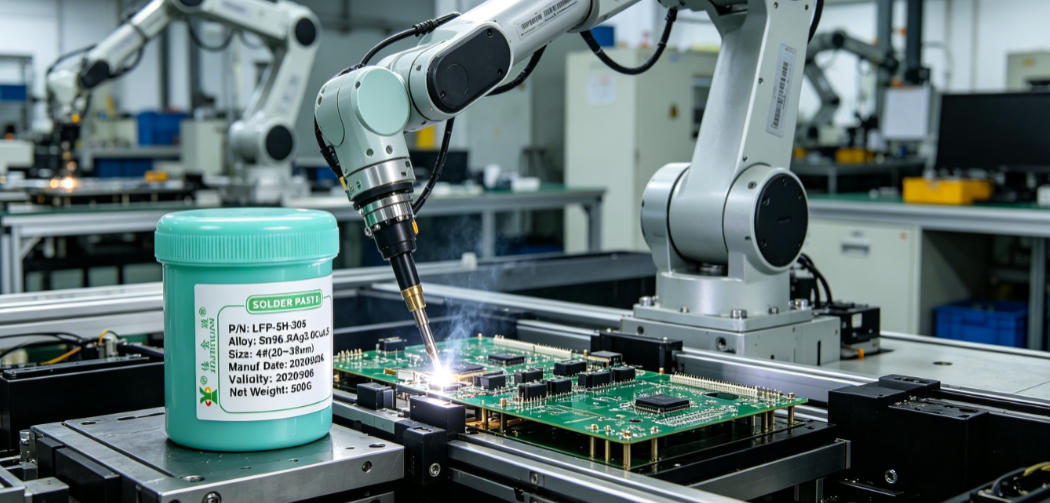
In SMT production of mixed panel assemblies, the splicing of PCBs with different sizes, thicknesses, and heat capacities makes it difficult to uniformly adapt the reflow profile. The mismatch between the activity window of solder paste and the actual temperature rise rhythm can easily cause defects such as cold solder joints, tombstoning, and cold soldering. This article directly addresses the real pain points of the production line, and provides an immediately executable collaborative solution for the reflow profile of mixed panel assemblies around four dimensions: solder paste selection, fine-tuning of furnace temperature zones, compensation of stencil apertures, and auxiliary heat equalization with carriers.
Published: 2026-08-27
A Practical Soldering Guide for Communication Motherboards for SMT Engineers, focusing on the material selection logic of solder paste and solder bars in high-frequency and high-speed signal scenarios. It covers hard parameters such as storage temperature and humidity, metal content, viscosity, particle size distribution, and reflow peak temperature. Combined with the stringent requirements for solder joint wettability and residual ion contamination of 0.3mm fine-pitch BGA and 10Gbps SerDes routing, it provides the specific application boundaries of IPC-J-STD-005 certified solder paste and Sn96.5Ag3.0Cu0.5 solder bars.
Published: 2026-08-27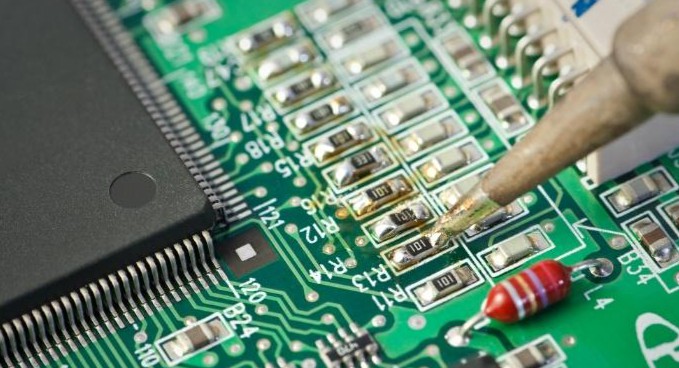
Addressing the industry pain point that solder joints on new energy electronic control boards are prone to cracking and have insufficient reliability under high-low temperature cycling conditions, Jiajinyuan has launched a variety of halogen-free and lead-free high-temperature solder pastes, covering segmented scenarios such as high solder climb for QFN/DFN, low void rate, zero halogen, and laser welding. Its 0307, 305 and other alloy systems at 240
Published: 2026-01-04By subjecting industrial control motherboard solder samples to combined accelerated aging, temperature cycling, and vibration stress tests, we realistically simulate a decade of service environment on the production line, focusing on the microcrack propagation rate of solder joints, changes in IMC layer thickness, and shear force attenuation trends, to provide reproducible failure boundary data for JJY's industrial control motherboard solder selection and reflow parameter optimization.
Published: 2025-11-25AOI inspection achieves millisecond-level image acquisition and defect identification in SMT production lines, enabling real-time interception of typical defects such as solder bridging, misalignment, and missing printing. Paired with the high-resolution industrial cameras and adaptive algorithms of Jiajinyuan AOI equipment, it increases defective board screening efficiency by more than 3 times, significantly reducing manual re-inspection rates and downstream rework costs.
Published: 2025-10-30Unstable soldering quality of OSP boards often stems from a mismatch between the activity of solder paste flux and the chemical stability of the OSP film, leading to poor wetting, cold solder joints, or blackened solder joints. Jiajinyuan series solder paste precisely removes the OSP film without corroding the copper surface through a gradient activity design, and its controllable stripping capability for 0.3μm thick OSP film has been verified on multiple production lines.
Published: 2025-09-27During the soldering rework of gold-plated boards, the gold layer is prone to oxidation by high temperatures or loss due to mechanical scraping, which leads to exposure of the nickel layer on the pad surface, poor wetting, and increased cold solder joints, directly affecting the long-term reliability of gold-plated board soldering. It is necessary to implement coordinated control from three aspects: soldering iron temperature, dwell time, and cleaning method.
Published: 2025-03-09Thick copper board welding must address three major challenges: large heat capacity, rapid heat dissipation, and difficult wetting caused by copper surface oxidation. During the SMT placement stage, the reflow peak temperature must be increased to 265℃±3℃ and the time above the liquidus line must be extended to over 90 seconds. For wave soldering, a combination of high-activity no-clean flux with a preheating temperature of 150℃, wave height of 10mm, and conveyor angle of 5° must be used. Otherwise, cold solder joints, excessive solder joint void rates, and pad peeling on thick copper PCBs are highly likely to occur.
Published: 2025-02-16When soldering communication base station motherboards with high-frequency boards, it is necessary to cope with long-term cyclic working conditions from -40℃ to +85℃. Jiajinyuan optimized solder paste selection, stencil aperture compensation, and segmented temperature control of the reflow soldering profile, reducing the solder joint void rate to ≤8%. After 2000 thermal shocks, the impedance fluctuation remains <3%, ensuring the stability of 5G millimeter-wave signal transmission.
Published: 2024-10-14Soldering on ENIG boards imposes extremely stringent requirements on the halogen residue, wettability, and residue insulation of solder paste. Halogen-free solder paste stands out in preventing excessive dissolution of the gold layer, reducing leakage current during ICT testing, and improving long-term reliability. Jiajinyuan's halogen-free solder paste has been validated on multiple high-end HDI board production lines, demonstrating stable printability under 0.3mm pitch QFN and 0.4mm BGA packages, along with an actual void rate of <8%.
Published: 2023-07-11Our technical team is always ready to provide professional solder material selection advice and SMT process solutions.