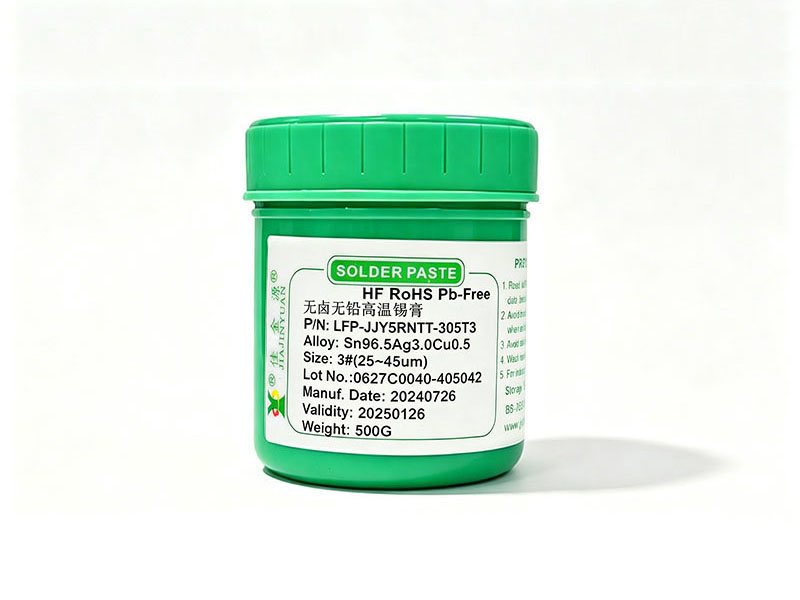
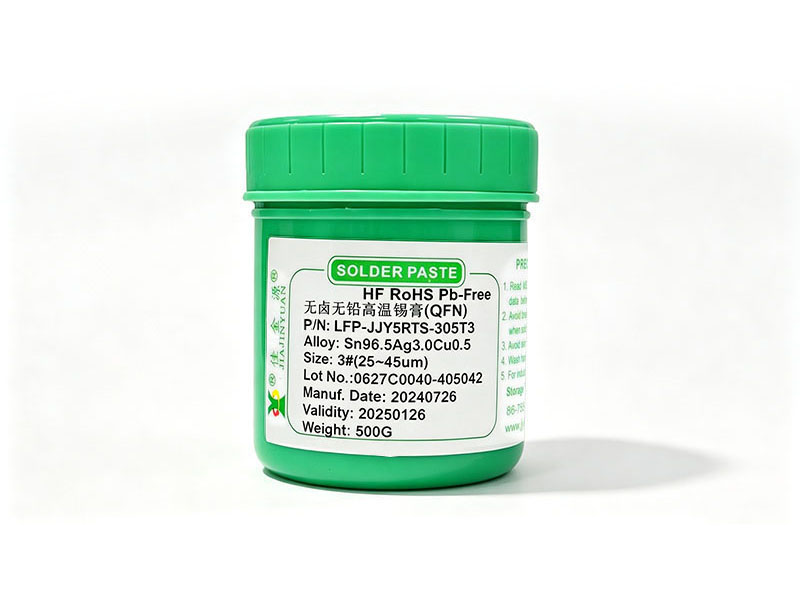
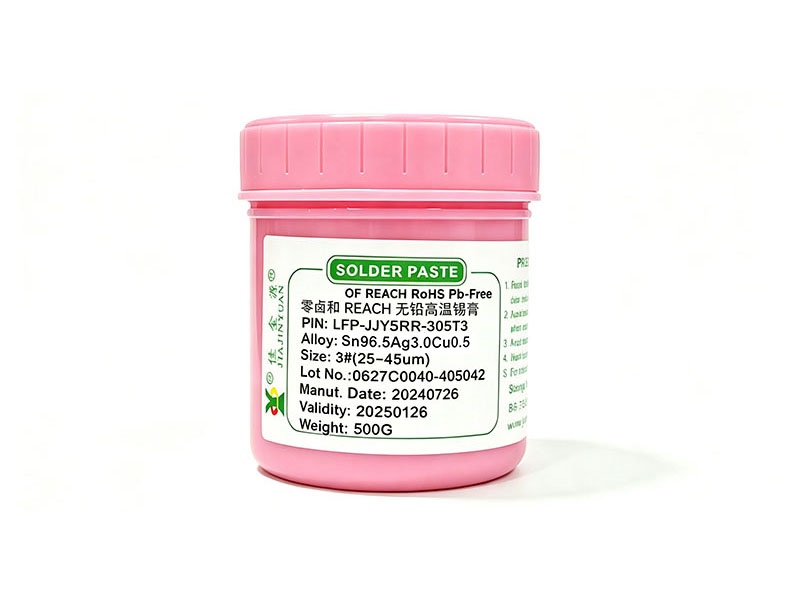
Solder Paste, Solder Wire, and Solder Bar each serve distinct roles in the electronics interconnection chain, yet they share identical base alloy systems such as Sn96.5Ag3.0Cu0.5 or Sn63Pb37, with differences arising primarily from physical form, Flux integration method, and delivery mechanics rather than fundamental metallurgy. Solder Paste consists of fine spherical alloy particles, typically ranging from 20 to 45 micrometers in diameter, uniformly suspended in a no-clean or water-soluble flux vehicle containing rheology modifiers, activators, and solvents, where the particle size distribution directly affects transfer efficiency during stencil printing and influences both bridging risk and void formation after reflow. Solder Wire features a continuous extruded core of the same alloy, surrounded by a concentric flux channel whose volume fraction, viscosity, and activation temperature must be tightly matched to tip geometry and operator speed to avoid cold joints or excessive spatter during manual or automated soldering. Solder Bar is cast into standardized ingots weighing 2 kg or 25 kg, with strict limits on oxygen content below 100 ppm and minimal segregation across the cross-section, ensuring consistent melting behavior and dross generation rate when fed into wave soldering tanks operating at 255–260°C.
The handling protocols diverge sharply due to these physical forms: Solder Paste requires refrigerated storage between 0–10°C and must undergo controlled ambient temperature equilibration for at least four hours before use to prevent condensation-induced flux separation, whereas Solder Wire can be stored at room temperature but demands protection from mechanical kinking and surface oxidation through sealed polyethylene packaging, and Solder Bar must be stacked vertically in dry, low-humidity environments to minimize surface oxide buildup that otherwise increases dross yield by up to 15% during molten bath replenishment. Printing performance of Solder Paste is highly sensitive to scraper angle, speed, and pressure, where deviations beyond 45–65°, 25–50 mm/sec, and 0.3–0.8 MPa respectively cause inconsistent fill or smearing, particularly on apertures below 0.3 mm pitch, while Solder Wire feed stability depends critically on pinch-wheel torque calibration and guide tube alignment, since even 0.1 mm lateral misalignment induces feeding hesitation or jamming in automated soldering heads. Solder Bar dissolution kinetics in wave soldering baths are governed by surface area-to-volume ratio and bath agitation level, meaning fragmented bars dissolve faster but increase dross if not preheated, whereas intact bars require longer immersion time but yield cleaner melt pools with lower entrapped oxide.
Flux chemistry remains the silent orchestrator across all three formats: in Solder Paste, the flux must remain thixotropic over multiple print cycles without sagging or slumping, yet release cleanly under reflow without residue-induced ICT test failures; in Solder Wire, the flux core must decompose fully between 150–200°C to expose clean metal surfaces before coalescence begins, otherwise incomplete activation leads to dewetting on OSP-finished PCBs; in Solder Bar, the flux is absent entirely, making native oxide control and bath additive management essential to sustain solderability over extended thermal cycling. Alloy grain structure also plays a role, Solder Paste particles are gas-atomized to achieve near-perfect sphericity and narrow size dispersion, Solder Wire undergoes multi-pass drawing and annealing to refine grain boundaries and improve ductility, and Solder Bar is directionally solidified to suppress micro-porosity and ensure uniform tensile strength above 45 MPa. Shelf life expectations reflect these differences: unopened Solder Paste lasts six months refrigerated, Solder Wire maintains usability for 24 months in sealed conditions, and Solder Bar remains viable indefinitely if protected from moisture and mechanical damage. Process engineers must therefore select not just alloy composition but delivery format based on line speed, joint geometry, defect sensitivity, and maintenance bandwidth, not as interchangeable commodities but as engineered subsystems with non-negotiable interface requirements.
Related Articles
- Raw Material Purity Standard for Solder Bar Alloy
- Microstructure Change of Solder Wire Joint
- Solder Paste, Solder Wire, Solder Bar Material Portfolio
- Solder Bar Production Quality Monitoring
- Active Flux Selection Guidance for Solder Paste
- Solder Wire Cost And Performance Balance
- Lead Free System Comparison of Solder Paste
- Joint Strength Characteristic of Solder Bar