


There are many reasons involved in this problem. For example: as a Low-temperature tin wire user, has the customer's welded PCB been cleaned? What is the spacing between solder joints on the board? The post-soldering insulation resistance of the Flux itself and the operating environment are all related. Shenzhen JJY analyzes the following points:
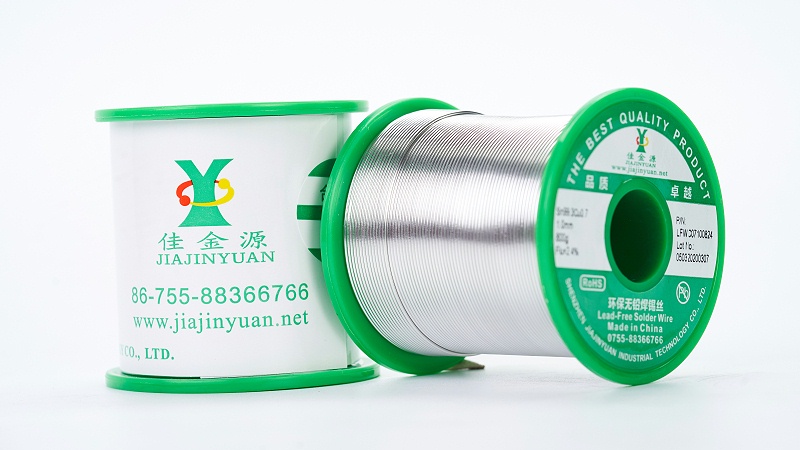
Understand the customer's entire soldering process, including whether the PCB has been cleaned after soldering. If leakage occurs even after cleaning, the main reason is a problem with the PCB itself — whether it has been cleaned thoroughly, and whether the cleaning agent causes corrosion or leaves harmful substances, resulting in electrical leakage.
The spacing of solder joints on the PCB and the insertion frequency between solder joints are also factors to consider for leakage. If the solder joint spacing is not close, or the insertion frequency of each solder joint is high, it is recommended that customers use rosin-core Solder Wire and clean after soldering, or use No-wash tin wire.
It is related to the post-soldering insulation resistance of the flux itself. Different types of fluxes have different insulation resistances, and the flux formulation mainly determines the insulation resistance. The rosin selected in the flux is also related to leakage. The higher the purity and grade of the rosin, the higher the insulation resistance.
The leakage problem is also related to the environment. After the PCB is soldered, if it is kept in a damp and cold environment for a long time, residual flux easily absorbs moisture and causes leakage. For example, the probability of leakage is relatively high on rainy days.
The Flux Content is also related to leakage. Under the condition that the soldering effect is acceptable, if the customer's process does not clean the PCB, the lower the flux content, the more stable the electrical characteristics — in other words, the lower the risk of leakage.
Taking all the above into consideration, a better way to avoid electrical leakage is to thoroughly clean the PCB, and there will be no leakage. The low-temperature tin wire of the Shenzhen JJY brand comes from 12 years of R&D in Solder Paste and solder wire. Solder wire — manufacturers of solder paste and wire for lead-free solder paste, Leaded Solder Paste, solder rods, etc.
Related Articles
- What are the characteristics of lead-free low-temperature tin wire? Jia Jinyuan is here to answer
- What should be noted when soldering with lead-free solder wire?
- Can low-temperature tin wire be used when facing the problem of difficult welding of lamp heads?
- How to solve the problem of leakage when soldering low-temperature tin wire?
- How to test the quality of solder paste and solder paste? JJY Solder Paste Manufacturer
- The influence of low-temperature solder wire solder joint brightness and how to improve it?
- What are the differences between high-temperature solder paste and low-temperature solder paste? JJY is here to popularize knowledge for everyone
- What are the reasons for the large amount of smoke in low-temperature tin wire soldering?


