SMT Solder Paste Manufacturers.

Focused on SMT soldering processes, a one-stop electronic soldering solutions provider.

Here you can find knowledge about Precision Instrument Solder, including but not limited to usage methods, installation techniques, troubleshooting and more. Focused on SMT soldering processes. If you can't find what you need, please contact us anytime.
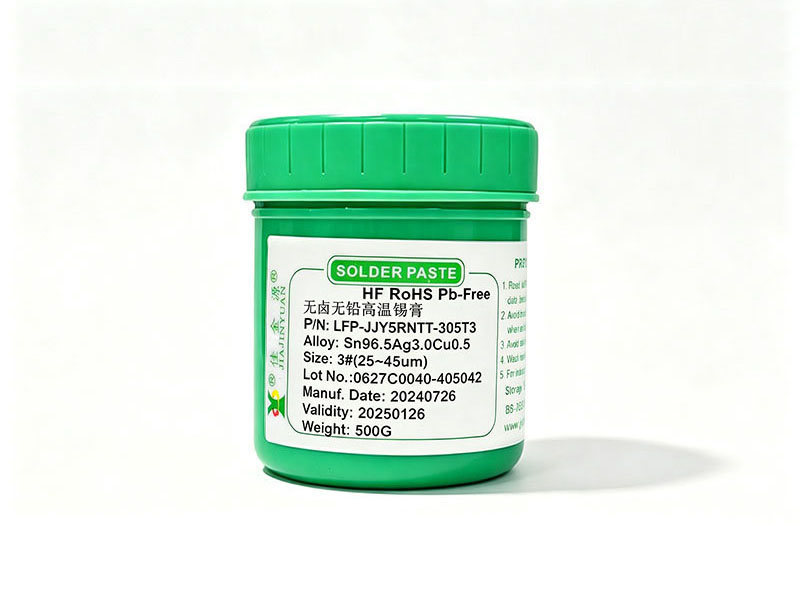
LFP?5RNTT?305 solder paste is specially designed for high-precision electronic devices such as mobile phones, Bluetooth, and fingerprint locks. Its halogen-free and lead-free properties and excellent solder climbing performance stand out in SMT processes, making it suitable for precise soldering of complex circuit boards, while meeting the dual environmental and reliability requirements of the ROL0 standard.
Published: 2026-08-28
The explosive growth of AI servers and AI terminal devices is driving the development of solder towards refinement and high reliability.
Published: 2026-08-24
The LFP-5RLJ series laser lead-free high-temperature solder paste and LFP-5RLJB laser medium-low temperature solder paste have achieved new breakthroughs in precision laser welding processes.
Published: 2026-08-24Conduct actual measurements on small-batch samples of sensor soldering solder to verify its wetting and spreading performance and void rate control capability under the conditions of 0.3mm pitch micro-pads and gold-plated nickel-palladium-gold surface treatment, with a focus on examining the bridging suppression effect and IMC layer uniformity of Jiajinyuan JH-851A lead-free solder at a peak temperature of 235℃ under a nitrogen atmosphere.
Published: 2022-10-29Nitrogen reflow in BGA/QFN precision soldering suppresses oxidation, improves wettability, and optimizes the flowability of molten metal, stably reducing the void rate from 18%~25% under air reflow to 4.2%~6.8%. The measured purity of the Jiajinyuan nitrogen generator reaches 99.999%, with a dew point ≤ -60℃. Combined with precise flow control (15~25L/min) and real-time monitoring of furnace oxygen concentration (≤100ppm), it can directly reuse existing reflow oven hardware to complete production line upgrades.
Published: 2022-09-19When SMT mounting 01005 and BGA precision components, extremely high placement accuracy is required. It is necessary to simultaneously control the nozzle vacuum stability, visual system calibration error, PCB thermal deformation, and solder paste collapse state. Any slight deviation will cause batch defects such as tombstoning, cold solder joints, and solder bridges. Actual measurements on the Jiajinyuan production line show that a placement offset exceeding 25 μm for 01005 devices leads to a 37% increase in open circuit rate after reflow. Poor coplanarity of BGA solder balls is directly related to placement pressure fluctuations exceeding 0.3 N.
Published: 2022-01-28
In 2021, the application of low-temperature solder paste in the consumer electronics field gradually expanded, mainly due to its advantages in protecting precision components and its soldering compatibility, making it an important factor driving the technological upgrading of the industry.
Published: 2021-12-30When reflow soldering precision BGA/QFN devices, the heating rate directly affects solder joint void ratio, solder ball collapse consistency, and PCB warpage risk. In particular, a preheat ramp exceeding 3℃/s can easily cause ceramic substrate cracking, while insufficient flux residue control occurs when the soak stage duration below 150℃ is less than 90 seconds. Jia Jinyuan's measured data shows that the void ratio of QFN bottom solder joints increases by 27% as the heating slope rises by 1.2℃/s. The temperature difference across the entire board must be controlled within ±2.5℃ to ensure first-pass yield.
Published: 2021-03-25When soldering precision sensor circuit boards with immersion silver boards, the excellent solder joint stability stems from the high density of the immersion silver layer, controllable interfacial reaction, and strong thermal cycle resistance. Jiajinyuan immersion silver boards have a measured thrust of over 85gf on 0.15mm fine-pitch BGA and 0.3mm pitch MEMS sensor pads, with an IMC thickness fluctuation of less than 0.12μm after reflow, significantly outperforming conventional OSP boards.
Published: 2015-01-17When reworking and welding precision motherboards, precise temperature control must be applied to protect surrounding micro components. The Jiajinyuan JRY-850B hot air system, paired with an infrared temperature gun for real-time feedback, controls the peak temperature of BGA solder joints at 235±2℃ and limits the temperature rise of surrounding 0201 resistors to below 120℃, avoiding PCB delamination or MLCC hidden cracks caused by thermal stress.
Published: 2014-01-10Our technical team is always ready to provide professional solder material selection advice and SMT process solutions.