SMT Solder Paste Manufacturers.

Focused on SMT soldering processes, a one-stop electronic soldering solutions provider.

Here you can find knowledge about Soldering Auxiliary Materials, including but not limited to usage methods, installation techniques, troubleshooting and more. Focused on SMT soldering processes. If you can't find what you need, please contact us anytime.
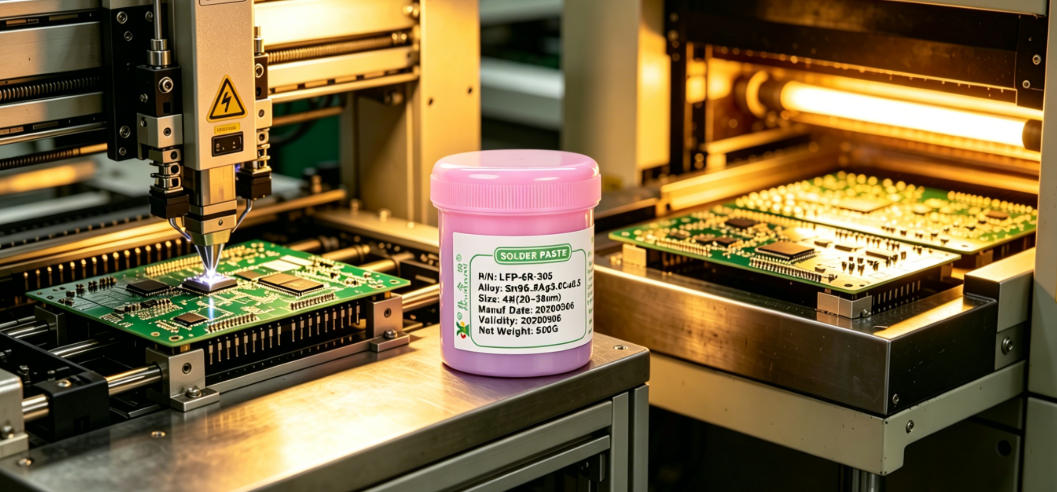
Dull solder joints after solder paste soldering are often not caused by a single factor, but rather the combined effect of multiple process variables such as insufficient solder paste activity, mismatched reflow temperature profile, unreasonable stencil aperture design, low nitrogen purity, or oxidation of PCB pads. Among these, the metal content of the solder paste itself and the flux system have the most direct impact on the final solder joint gloss.
Published: 2025-10-06Unstable soldering quality of OSP boards often stems from a mismatch between the activity of solder paste flux and the chemical stability of the OSP film, leading to poor wetting, cold solder joints, or blackened solder joints. Jiajinyuan series solder paste precisely removes the OSP film without corroding the copper surface through a gradient activity design, and its controllable stripping capability for 0.3μm thick OSP film has been verified on multiple production lines.
Published: 2025-09-27In the SMT soldering production line, solder paste thawing and stirring operations directly affect printing yield and reflow soldering void rate. Jia Jinyuan solder paste must be left to stand in an environment of 22℃±2℃ for more than 4 hours to be fully thawed. Stirring must adopt a dual-parameter locked mode with a constant speed of 60rpm and a duration of 120 seconds; otherwise, defects such as solder balls, solder spikes, and solder paste collapse are likely to occur.
Published: 2025-09-10Reflow soldering is a key step in the SMT placement process to achieve metallurgical bonding of component pads. Solder paste goes through four stages in the reflow oven: preheating, soaking, reflow, and cooling, to complete melting and wetting. Its temperature profile setting, furnace temperature uniformity, and solder paste activity directly affect solder joint strength and void rate.
Published: 2025-07-04
In manual soldering, the selection of solder wire diameter directly affects drag soldering efficiency and solder joint formation quality. Thick solder wire is suitable for large-area pads and quick solder replenishment but is prone to causing bridging, while thin solder wire facilitates precise pin control but imposes higher requirements on operation rhythm. Actual production lines need to comprehensively weigh factors based on PCB pad size, component spacing, and operation takt time.
Published: 2025-05-11Pin dip soldering using tin bars for molten tin is an efficient process for high-volume component preprocessing. It achieves uniform tin plating on pin surfaces through constant-temperature bath control, pre-coating of flux, and vertical immersion, significantly improving subsequent SMT placement yield and reflow soldering wettability. Jiajinyuan tin bars exhibit stable fluidity and minimal dross in the 183°C–205°C range, meeting the continuous operation requirements of pre-wave soldering processes.
Published: 2025-04-20During the soldering rework of gold-plated boards, the gold layer is prone to oxidation by high temperatures or loss due to mechanical scraping, which leads to exposure of the nickel layer on the pad surface, poor wetting, and increased cold solder joints, directly affecting the long-term reliability of gold-plated board soldering. It is necessary to implement coordinated control from three aspects: soldering iron temperature, dwell time, and cleaning method.
Published: 2025-03-09Thick copper board welding must address three major challenges: large heat capacity, rapid heat dissipation, and difficult wetting caused by copper surface oxidation. During the SMT placement stage, the reflow peak temperature must be increased to 265℃±3℃ and the time above the liquidus line must be extended to over 90 seconds. For wave soldering, a combination of high-activity no-clean flux with a preheating temperature of 150℃, wave height of 10mm, and conveyor angle of 5° must be used. Otherwise, cold solder joints, excessive solder joint void rates, and pad peeling on thick copper PCBs are highly likely to occur.
Published: 2025-02-16
The voids in solder joints formed by bar solder wave soldering are closely related to the material properties of the solder bar. Excessive impurity elements such as arsenic and antimony in high-purity lead-free solder bars will significantly aggravate void formation, while an imbalanced tin-copper alloy ratio or fluctuations in silver content directly affect the surface tension and wetting behavior in the molten state, thereby altering the gas escape paths inside the solder joint.
Published: 2025-01-19Medical electronic equipment has extremely stringent requirements for the purity, ionic residue and long-term reliability of solder materials. With its strictly controlled metal composition, low halogen content and batch stability, ISO solder materials have become the first choice for SMT production lines of implantable and monitoring devices. Jiajinyuan ISO solder materials have passed the biocompatibility pre-assessment of IEC 60601-1 Appendix A. In actual production lines, the ionic residue on the board surface after reflow is <0.85μg/cm2, and the copper mirror corrosion test shows no discoloration for over 72 hours.
Published: 2025-01-15Our technical team is always ready to provide professional solder material selection advice and SMT process solutions.