SMT Solder Paste Manufacturers.

Focused on SMT soldering processes, a one-stop electronic soldering solutions provider.

Here you can find knowledge about Soldering Auxiliary Materials, including but not limited to usage methods, installation techniques, troubleshooting and more. Focused on SMT soldering processes. If you can't find what you need, please contact us anytime.

The occurrence of solder balling during the reflow soldering process is not necessarily a quality issue with the solder paste itself; it is more often related to the coupling of multiple factors such as printing parameters, stencil design, temperature zone settings, and ambient humidity. Especially when the solder paste is unevenly heated during the reflow stage or the solvent volatilizes insufficiently, splashing-type solder balls are highly likely to be induced. Therefore, troubleshooting should start from the storage conditions of the solder paste, the matching of the reflow soldering profile, and the coordination of the PCB pad layout.
Published: 2024-12-02When soldering communication base station motherboards with high-frequency boards, it is necessary to cope with long-term cyclic working conditions from -40℃ to +85℃. Jiajinyuan optimized solder paste selection, stencil aperture compensation, and segmented temperature control of the reflow soldering profile, reducing the solder joint void rate to ≤8%. After 2000 thermal shocks, the impedance fluctuation remains <3%, ensuring the stability of 5G millimeter-wave signal transmission.
Published: 2024-10-14Soldering 01005 components poses extreme challenges to the accuracy of high-speed placement machines, the consistency of solder paste printing, and the uniformity of the reflow soldering thermal field. Through dual-track synchronous visual positioning, 0.02mm-level Z-axis closed-loop compensation, and a gradient temperature zone control system, Jiajinyuan equipment controls solder joint offset within ±12μm in mass production, effectively addressing typical failures such as tombstoning, cold solder joints, and uneven pad wetting during 01005 component soldering.
Published: 2024-08-21PCBA soldering materials have complete SGS certifications, covering all categories including lead-tin alloys, lead-free solder pastes, fluxes and cleaning agents, and comply with mandatory export standards such as IEC 61249, RoHS 2.0 and REACH. They can be directly used for complete machine exports to the EU, North America, Japan and South Korea, avoiding customs clearance delays or batch returns caused by missing material qualifications.
Published: 2024-07-14
Whether solder bars can be mixed depends on the compatibility of alloy compositions and the matching degree with the process window of the wave soldering machine. Mixing different alloy solders can easily lead to risks such as melting point shift, uneven wetting, and embrittlement of solder joints. In actual production lines, common phenomena include increased solder dross, solder joint spikes, or cold solder joints. It is recommended to give priority to using solder bars from the same manufacturer and the same batch to ensure the stability of the alloy solder composition and the consistency of soldering.
Published: 2024-06-27Cold soldering is the most hidden fatal defect in SMT production lines. Insufficient reflow peak temperature prevents the solder paste from fully melting and wetting the pads, resulting in cold solder joints and false soldering. Jia Jinyuan solder paste can only complete the eutectic reaction above 183°C, and its wetting force drops sharply when the temperature is below 205°C. Cold solder joints have a gray surface without metallic luster, and the thrust test value is more than 50% lower than the standard value.
Published: 2024-06-15Low-smoke solder wire for connector soldering is designed for high-volume automated soldering lines, addressing the pain points of traditional solder wires such as heavy smoke, excessive spatter, and poor wettability. It significantly reduces TVOC concentrations in the operation area while ensuring high electrical conductivity and mechanical strength. Compatible with automatic wire feeders for wire diameters ranging from 0.3 to 1.2 mm, it has achieved stable continuous feeding for 8 hours without downtime on customer production lines of Jiajinyuan.
Published: 2024-05-27Dip soldering is a key process that completes batch soldering by vertically immersing PCB pins into the surface of molten solder using a manual dip soldering machine or a wave soldering machine. Its core lies in the coordinated control of solder temperature, immersion depth, and dwell time. Jiajinyuan equipment has verified in actual production lines that a temperature control accuracy of ±2℃ and a standard dip soldering window of 0.8~1.2 seconds can effectively suppress defects such as cold solder joints and bridging.
Published: 2024-04-29In formic acid atmosphere vacuum reflow soldering, solder paste must balance activity control and bubble removal; vacuum solder paste must have low vapor pressure, high thermal stability, and formic acid compatibility, while formic acid reflow solder paste requires a flux system that can synergistically reduce oxides with formic acid without exacerbating metal corrosion. These three factors jointly determine the void fraction and shear strength of solder joints in high-power devices.
Published: 2024-04-21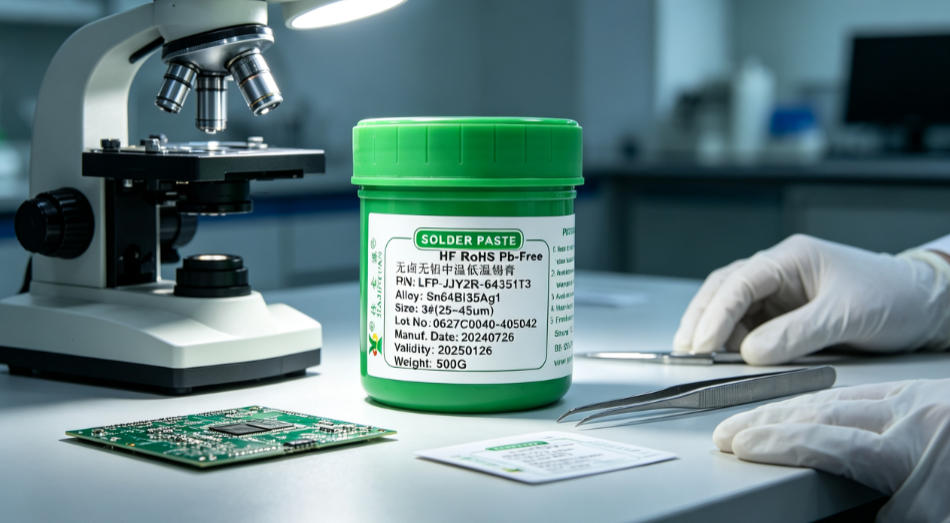
Flux paste and solder paste have completely different functional roles in SMT placement soldering. Flux paste contains no metal powder and has no forming capability, so it cannot replace solder paste to achieve solder joint bonding and structural support. It can only serve as an auxiliary supplement to solder paste or a flux reinforcement method for local rework.
Published: 2024-04-09Our technical team is always ready to provide professional solder material selection advice and SMT process solutions.