SMT Solder Paste Manufacturers.

Focused on SMT soldering processes, a one-stop electronic soldering solutions provider.

Here you can find knowledge about SMT Solder, including but not limited to usage methods, installation techniques, troubleshooting and more. Focused on SMT soldering processes. If you can't find what you need, please contact us anytime.
In the entire chip soldering process, the precision of solder paste printing via SMT stencil directly determines the yield of subsequent component placement and reflow soldering. The viscosity, particle size, and metal content of the solder paste, as well as printing parameters such as squeegee pressure, speed, and release distance, must be coordinated and matched with the actual conditions of the production line. Any mismatch will cause typical defects such as insufficient solder, solder bridging, and misalignment.
Published: 2017-09-07High-viscosity solder paste significantly improves the placement offset issues of 0201, 0402 and other tiny components as well as irregular devices in SMT production, and is especially suitable for complex scenarios such as double-sided reflow, stepped stencils, and high-density board layouts. Its characteristics of strong thixotropy, low slump rate, and long room-temperature holding time reduce the component displacement rate during the solder paste placement process by more than 40%, while easing the pressure on the waiting window from after printing to before placement.
Published: 2017-04-26SMT stencils are core consumables in the SMT solder paste printing process. Their aperture size, thickness, surface treatment, and tension state jointly determine the stability of solder paste transfer volume. Jiajinyuan SMT stencils, through laser cutting precision control and electropolishing process optimization, achieve a solder paste transfer rate of over 92% at a thickness of 0.12mm, effectively suppressing common high-frequency production line defects such as insufficient solder, solder bridging, and edge burrs.
Published: 2017-04-18SMT placement pressure control directly affects the deformation state of solder paste. Excessive pressure will cause the solder paste to be squeezed laterally to both sides of the pad, leading to bridging defects. JIAJINYUAN placement machines achieve ±0.02N precision control through real-time pressure feedback and Z-axis dynamic compensation, combined with stencil aperture design matched with the rheological properties of solder paste, to suppress bridging from the source.
Published: 2017-03-09To address the frequent occurrence of batch SMT defects, this paper proposes a practical method based on coordinated troubleshooting across three key stages: solder paste printing, placement offset, and reflow profile. By leveraging rapid microscopic comparison, first-article parameter traceability, and cross-validation of measured reflow temperature data, the root cause can be identified within 30 minutes, significantly reducing production line downtime and effectively controlling the spread risk of SMT defects.
Published: 2016-10-12AOI inspection after SMT reflow soldering can efficiently identify appearance soldering defects such as solder joint bridging, tombstoning, solder beads, and misalignment, greatly reducing the missed inspection rate of manual visual inspection. With a pixel accuracy of 0.015mm and the capability of multi-angle light source switching, Jia Jinyuan's AOI inspection equipment stably controls the false alarm rate within 1.2% for solder joint judgment of components below 0603.
Published: 2016-07-14First Article Inspection is a full-item verification action performed on the first PCB after the SMT production line starts up and changes boards, covering key links such as solder paste printing, placement accuracy, reflow soldering effect, and AOI false alarm rate. It compares measured data with process parameters and BOM/GERBER consistency to avoid risks of batch material misplacement, offset, or cold soldering, ensuring an accurate and reliable starting point for process control.
Published: 2016-05-17In SMT printing, the rheological properties of solder paste directly affect continuous printing stability. An excessively high thixotropic index easily leads to poor demolding and edge pinholes, while an excessively low thixotropic index causes slump and aperture clogging. Jiajinyuan solder paste achieves precise control of the viscoelasticity ratio. Under 25°C environment and 0.5mm stencil conditions, the measured thixotropic index is 1.8~2.3. Combined with the parameter set of squeegee pressure 2.8kg and speed 45mm/s, it can continuously complete 1200 PCBs without aperture clogging.
Published: 2016-04-10SMT quality control requires regular oven temperature testing to verify reflow soldering stability, combined with 100% automatic identification of solder joint appearance defects via AOI, and periodic sampling inspection of internal voids and cold solder joints in BGA and QFN via X Ray. The three work in coordination to form a three-dimensional defense line covering thermal processes, apparent quality and hidden defects, ensuring the consistency of mass production batches.
Published: 2015-09-21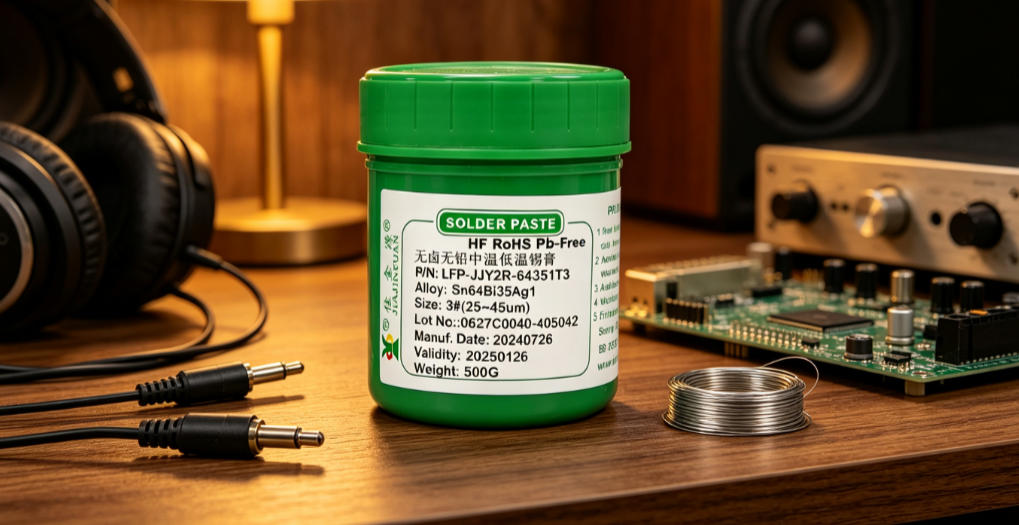
When changing solder paste brands during SMT production, a strict SMT verification process must be implemented, covering multi-dimensional tests such as printability, mountability, reflow performance, and solder joint reliability. The focus is on monitoring changes in solder paste viscosity, stencil life attenuation, and the incidence of solder balls and bridging, to avoid batch cold solder joints or tombstoning defects caused by batch switching.
Published: 2015-08-09Our technical team is always ready to provide professional solder material selection advice and SMT process solutions.