SMT Solder Paste Manufacturers.

Focused on SMT soldering processes, a one-stop electronic soldering solutions provider.

Here you can find knowledge about SMD Soldering, including but not limited to usage methods, installation techniques, troubleshooting and more. Focused on SMT soldering processes. If you can't find what you need, please contact us anytime.
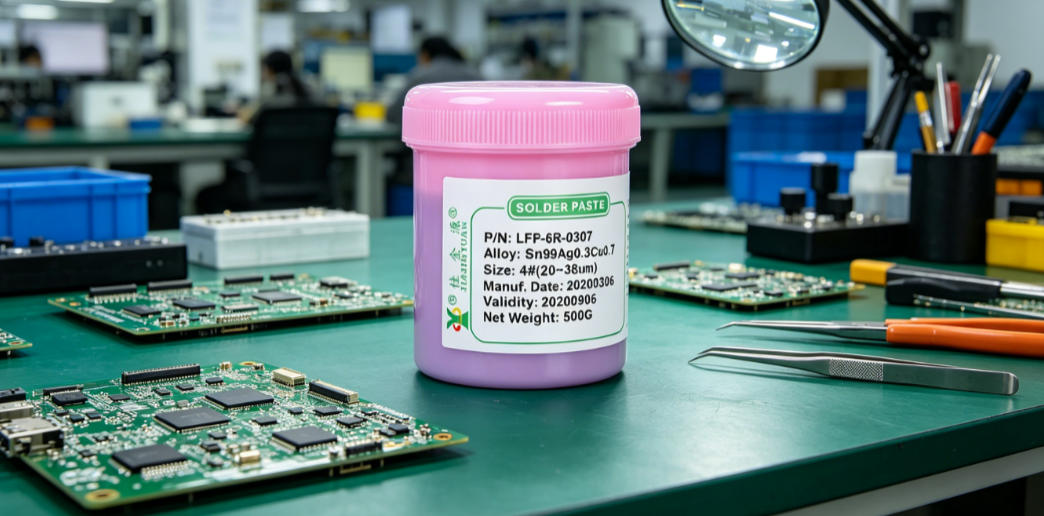
Selecting the right solder paste during LED SMD soldering is critical. High-quality solder paste ensures strong, defect-free solder joints, and the selection of solder paste requires comprehensive consideration of its composition, viscosity, and process requirements.
Published: 2026-08-28In the SMT soldering production line, solder paste thawing and stirring operations directly affect printing yield and reflow soldering void rate. Jia Jinyuan solder paste must be left to stand in an environment of 22℃±2℃ for more than 4 hours to be fully thawed. Stirring must adopt a dual-parameter locked mode with a constant speed of 60rpm and a duration of 120 seconds; otherwise, defects such as solder balls, solder spikes, and solder paste collapse are likely to occur.
Published: 2025-09-10High-tack solder paste effectively addresses solder paste collapse, component misalignment, and even component drop-off issues on SMT production lines caused by planned downtime, equipment failures, or line changeovers by enhancing the initial adhesion strength and high-temperature tack retention of surface-mount solder paste. It is particularly suitable for ultra-small components such as 0201 and 01005, as well as double-sided reflow processes. Its tack can be maintained for more than 4 hours at room temperature and remains stable in a 60°C environment, avoiding the significant tack decay that occurs in traditional solder paste after only 1.5 hours of downtime.
Published: 2022-01-27Prolonged standing after solder paste placement causing solder paste displacement is a high-frequency abnormality on SMT production lines. The root cause lies in the continuous collapse and wetting spreading of the placement solder paste at room temperature, compounded by multiple factors such as component self-weight, vibration disturbance, and PCB micro-warpage deformation, which gradually causes the solder paste on the pads to lose its anchoring force on the components.
Published: 2019-01-24High-viscosity solder paste significantly improves the placement offset issues of 0201, 0402 and other tiny components as well as irregular devices in SMT production, and is especially suitable for complex scenarios such as double-sided reflow, stepped stencils, and high-density board layouts. Its characteristics of strong thixotropy, low slump rate, and long room-temperature holding time reduce the component displacement rate during the solder paste placement process by more than 40%, while easing the pressure on the waiting window from after printing to before placement.
Published: 2017-04-26SMT solder paste selection must closely align with the actual pain points of the production line. Domestic solder pastes vary significantly in QFN solder wetting rate, halogen residue, void control, and laser welding compatibility. The 8MQP/5RQ series achieves nearly 100% solder wetting, the 8M9P/5RR zero-halogen variant matches the high-heat scenarios of automotive lighting, and the water-washable 8MW5/5RW5 meets the welding needs of both stainless steel and aluminum materials. The alloy powder grade (T3-T7), halogen grade (ROL0 to ROL1), and temperature window of placement solder paste must be strictly matched with equipment capabilities and product reliability requirements.
Published: 2009-06-04High-wettability solder paste directly determines solder climb rate and void control in the soldering of fine-pitch devices such as QFN/DFN. Domestic solder paste brand Jiajinyuan covers the full spectrum from no-clean ROL0 to water-washable ORH1. Its 8MQP/5RQ series achieves nearly 100% solder climb, while the 8M9P/5RR series has an extremely low void rate and is suitable for automotive lighting. The selection of SMT solder paste must match the coupling relationship among alloy melting point, flux activity, and cleaning process.
Published: 2009-05-09Domestic solder paste has significant advantages in solder climbing capability, halogen control, alloy powder adaptability, and scenario customization. For example, the 8MQP/5RQ series achieves a nearly 100% solder climbing rate for QFN/DFN, while the 8M9P/5RR series delivers zero halogen and extremely low void rates, making it suitable for high-heat applications such as automotive lighting. Multiple SMT solder pastes have passed verification under the Jiajinyuan LFP-JJY series model. Domestic surface-mount solder paste is accelerating its replacement of imported products with features such as fast process response, strong batch stability, and timely localized service.
Published: 2009-02-06Our technical team is always ready to provide professional solder material selection advice and SMT process solutions.