SMT Solder Paste Manufacturers.

Focused on SMT soldering processes, a one-stop electronic soldering solutions provider.

Here you can find knowledge about Tin Ingot, including but not limited to usage methods, installation techniques, troubleshooting and more. Focused on SMT soldering processes. If you can't find what you need, please contact us anytime.

The melting temperature of solder paste is a key parameter in the soldering process, directly affecting solder joint quality and production efficiency. Solder pastes of different compositions have different melting temperature ranges, and selecting the appropriate solder paste requires consideration of specific application scenarios and equipment conditions.
Published: 2026-08-28
Solder paste printing is a critical step in the SMT process, directly affecting soldering quality and product reliability. In practice, parameters must be adjusted according to the printer model, stencil aperture design, and component density to ensure the solder paste evenly covers the pads and prevent cold solder joints or short circuits.
Published: 2026-08-28
The temperature selection of emmc solder paste directly affects the soldering effect, and choosing the appropriate solder paste temperature can improve soldering quality. In actual operation, comprehensive judgment should be made based on solder characteristics, equipment conditions and process requirements to ensure a stable and reliable soldering process.
Published: 2026-08-28
Solder paste melting is a key step in the SMT process, directly affecting soldering quality. By properly controlling the temperature profile, solder paste characteristics, and equipment parameters, ensure that the solder paste melts uniformly during reflow soldering, avoiding cold solder joints and bridging issues.
Published: 2026-08-28
Solder paste is an indispensable soldering material in the SMT process, and whether tin powder and soldering flux can be used to make solder paste has become a focus of attention in the industry. By analyzing the composition and production principle of solder paste, this paper clarifies the limitations of tin powder and soldering flux in practical applications, and provides professional guidance for related operations.
Published: 2026-08-28
The melting temperature of solder paste is a key parameter in the SMT process, which directly affects soldering quality and production efficiency. In actual production, the temperature range must be precisely controlled according to the solder composition and equipment conditions to avoid defects such as cold solder joints and bridging caused by excessively high or low temperatures.
Published: 2026-08-28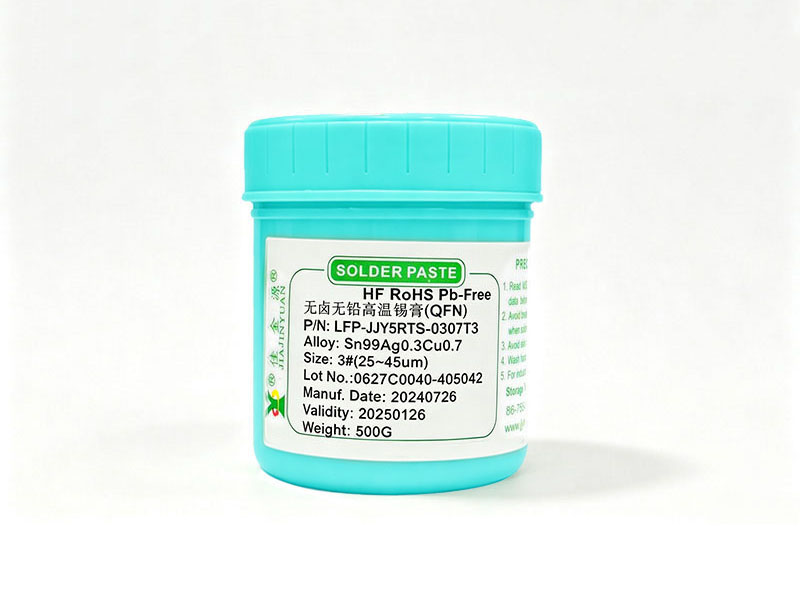
LFP?5RTS?0307 translucent residual solder paste demonstrates stable performance in medium solder fillet formation mass production for QFN/DFN packages, offers good process adaptability, and its no-clean feature significantly reduces post-processing costs, making it suitable for high-density electronic manufacturing scenarios.
Published: 2026-08-28
For large-pitch conventional SMT production scenarios for LEDs, LFP-8MA-SC07 lead-free solder paste, with its high activity, low residue, and good solder climbing performance, is an ideal soldering material in the lighting industry and is suitable for conventional process requirements.
Published: 2026-08-28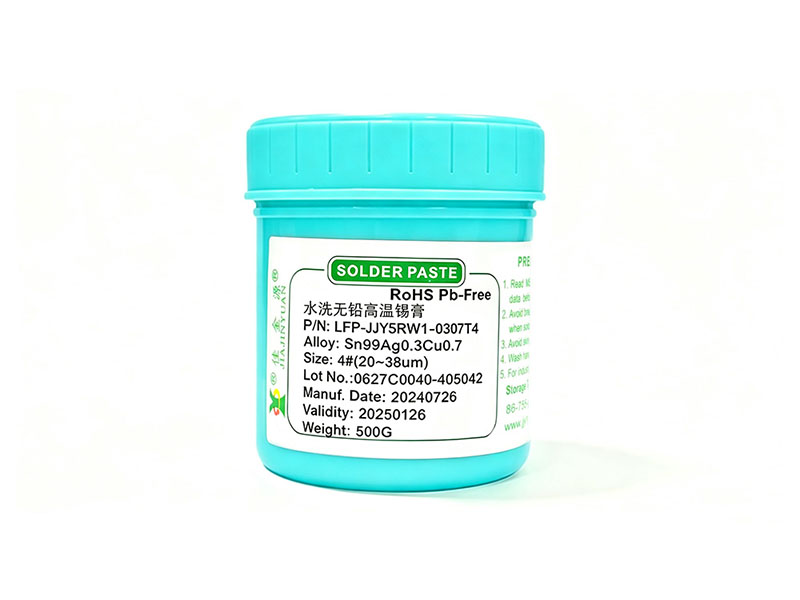
The selection of LFP?5RW1?305 water-washable high-temperature solder paste should be based on water washing process requirements and soldering temperatures, to ensure that residues are water-washable and meet high-activity demands. It is suitable for complex packaging scenarios such as QFN/DFN. During selection, attention should be paid to the matching between alloy powder particle size and post-soldering performance.
Published: 2026-08-28
Domestic halogen-free solder paste LFP?5RQ?0307 achieves nearly 100% solder wetting in QFN packages, with its high activity and alloy powder characteristics being the key factors. Optimizing printing parameters and reflow profile can further improve soldering quality.
Published: 2026-08-28Our technical team is always ready to provide professional solder material selection advice and SMT process solutions.