SMT Solder Paste Manufacturers.

Focused on SMT soldering processes, a one-stop electronic soldering solutions provider.

Here you can find knowledge about Fine-Pitch Solder Paste, including but not limited to usage methods, installation techniques, troubleshooting and more. Focused on SMT soldering processes. If you can't find what you need, please contact us anytime.
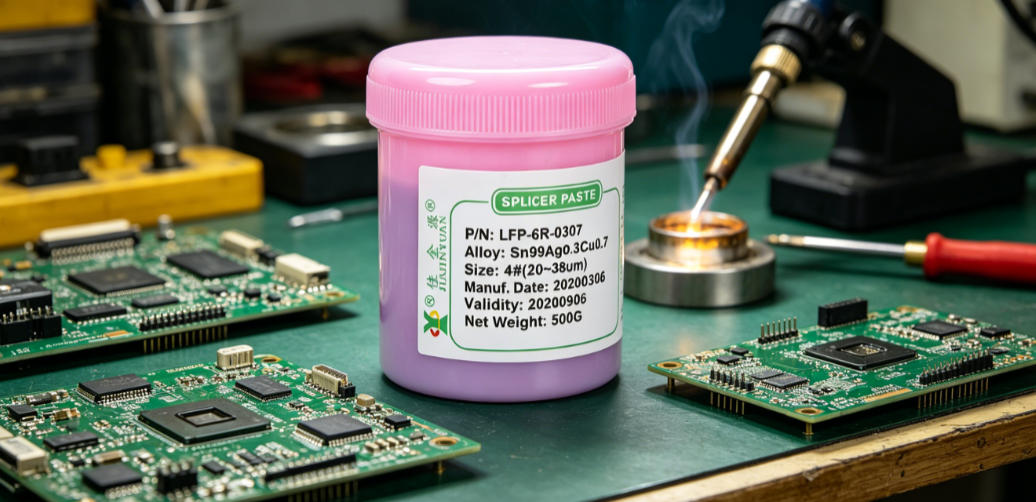
Abnormal solder paste viscosity during SMT soldering of fine-pitch chips can lead to typical defects such as solder bridging, insufficient solder, and misalignment. Based on real production line fault scenarios, this paper analyzes the causal chain between solder paste viscosity fluctuations and mismatched stencil printing parameters, and provides emergency and fundamental solutions including fine-tuning of squeegee pressure, environmental temperature and humidity control, and standardization of solder paste warm-up and stirring.
Published: 2026-08-27
Frequent solder bridging short-circuit issues in fine-pitch ICs often stem from mismatched solder paste viscosity with printing accuracy and reflow behavior. Based on 20 years of measured data from SMT production lines, this paper points out that solder paste viscosity needs to be controlled within the range of 350±30Pa·s to balance squeegee transfer rate and pad retention, while reducing the risk of solder bridging in fine-pitch ICs.
Published: 2026-08-27
Soldering of miniature components imposes stringent requirements on solder paste particle size and rheological properties. Fine-particle solder paste, with its 4-6μm spherical particles, viscosity of 320±30Pa·s at 25±2℃, and compatibility with 120-mesh stencils, significantly improves printing accuracy and solder joint consistency in the mounting of miniature components such as 0201 and 01005.
Published: 2026-08-27Bridge is one of the most common and hardest-to-eliminate defects in fine-pitch IC soldering, manifesting as abnormal molten solder connection between adjacent pins that causes short circuits. Production line data from Jia Jinyuan shows that bridges account for over 67% in QFN0.4mm and BGA0.3mm packages, with the root causes concentrated in the combination of solder paste printing misalignment, improper stencil aperture design, and local overshoot of peak reflow soldering temperature.
Published: 2026-06-23Solder paste selection must match the actual pad pitch and stencil aperture size. T3 to T6 solder powder particle sizes directly affect the printing accuracy and slump control of fine-pitch solder paste. Among them, T4 (25–45μm) is suitable for 0.4mm pin pitch, T5 (15–25μm) is adapted for fine-pitch solder paste applications of 0.3mm and below, while T6 (5–15μm) is only limited to CSP or FCCSP packages below 0.2mm and requires nitrogen reflow and high-precision printing equipment.
Published: 2024-08-14SMT stencils face frequent bridging and solder ball defects in fine-pitch IC printing. Micro-hole laser stencils significantly reduce short-circuit rates on devices with a pitch below 0.3mm by precisely controlling aperture size, wall roughness, and taper structure. Mass production verification by Jiajinyuan shows that bridging defects decreased by 62%, solder ball occurrence reduced by 78%, directly improving the first-pass yield.
Published: 2021-08-14In fine-pitch pin printing, the pinhead phenomenon directly affects solder paste transfer rate and subsequent placement accuracy. It is necessary to synchronously monitor the length, morphology and repeatability of pinheads during first article inspection, in-process patrol inspection and stencil cleaning. Production line data from JJY shows that for 0.4mm pitch QFN devices, a pinhead exceeding 0.15mm will trigger the risk of solder bridging.
Published: 2020-07-24In fine-pitch IC reflow soldering, the metal content, particle size distribution and flux activity of solder paste must match pad pitches below 0.4mm. Yield fluctuations exceeding 30% in reflow soldering often stem from uneven solder paste collapse or insufficient wetting after reflow. For Jiajinyuan JH-812A, the measured bridging rate on 0.35mm pitch QFN is below 0.12%. Its 25μm median particle size and 55% metal content work synergistically to suppress printing misalignment and reflow splattering.
Published: 2020-06-11To address the unstable yield of 0.4mm and below fine-pitch solder paste printing, this paper, based on 20 years of measured data from the Jiajinyuan production line, clarifies that the stencil aperture ratio needs to be dynamically adjusted within the range of 75% to 85%. Among them, 82% is recommended for QFN0.4mm, and it must be reduced to 76% for BGA0.3mm. It is also pointed out that an aperture ratio deviation exceeding ±3% will cause solder bridging or insufficient solder. The core lies in balancing the solder paste release rate and the stencil demolding capability.
Published: 2016-11-09Excess solder is a core defect causing short circuits, bridging and cold solder joints in fine-pitch IC production, and its occurrence is strongly coupled with stencil aperture design, squeegee pressure, solder paste rheological properties and reflow parameters. Production line data from Jiajinyuan shows that over 63% of solder defects caused by excess solder are directly associated with solder paste printing thickness exceeding the standard by more than 0.02 mm, and strict control of excess solder has become a rigid threshold for improving the yield of CSP and QFN 0.4 mm pitch devices.
Published: 2016-02-04Our technical team is always ready to provide professional solder material selection advice and SMT process solutions.