SMT Solder Paste Manufacturers.

Focused on SMT soldering processes, a one-stop electronic soldering solutions provider.

Here you can find knowledge about BGA Solder Paste, including but not limited to usage methods, installation techniques, troubleshooting and more. Focused on SMT soldering processes. If you can't find what you need, please contact us anytime.
During the BGA welding rework and ball mounting process, the molding stability of solder paste directly determines the ball mounting yield and subsequent reflow soldering reliability. Jiajinyuan solder paste demonstrates excellent anti-offset capability in 0.3mm pitch BGA ball mounting. The synergistic control of its thixotropic index and pre-reflow collapse amount keeps the center offset of the solder balls stably controlled within ±15μm.
Published: 2017-05-28The solder used in energy storage modules is extremely sensitive to voiding rate. Low-void solder paste can control the voiding rate of BGA solder joints within 5%, significantly improving the thermal fatigue life of electronic control boards under high-power cycling. Jiajinyuan JY-810A solder paste, with its stable thixotropy, low residue, and reflow wetting angle of less than 25°, has become a practical combination for BGA soldering of electronic control boards in the selection of solder materials for energy storage modules.
Published: 2017-04-04BGA chip reballing repair relies on precise reballing processes. Jiajinyuan's dedicated solder paste works in synergy with matching solder balls to ensure solder joint coplanarity, tensile strength, and void rate meet standards. This solution has been verified on multiple production lines to stably pass 500 cycles of -40℃~125℃ thermal shock without defects such as solder bridging, cold solder joints, or ball misalignment.
Published: 2016-01-29BGA soldering quality is highly dependent on the rheological properties and reflow behavior of solder paste. Low-void solder paste, by optimizing metal content, flux activity and particle distribution, significantly reduces solder joint void rate to below 3% in actual production lines, and has become a core material for improving BGA soldering first-pass yield and long-term reliability.
Published: 2014-12-05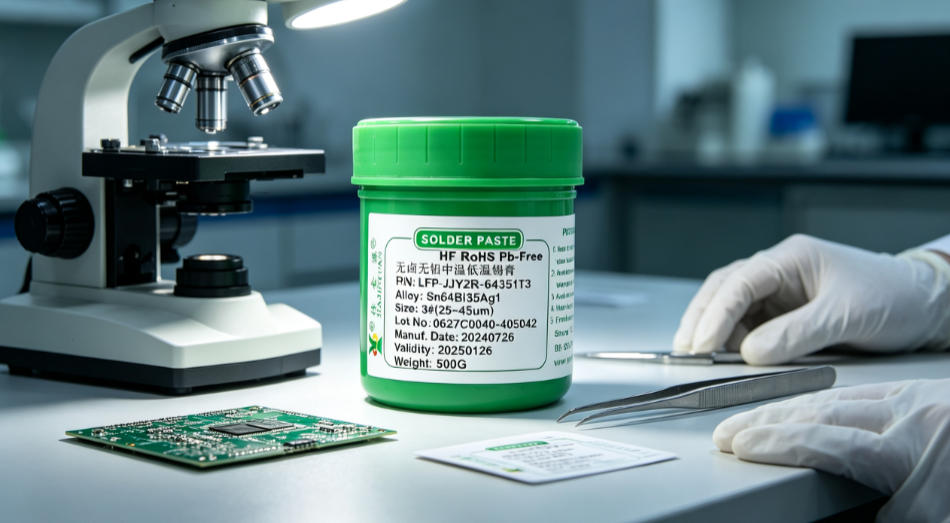
In BGA chip repair, the synergistic use of solder paste and flux paste directly affects ball mounting yield and soldering reliability. In actual production lines, the flux paste application amount and solder paste printing thickness must be dynamically adjusted based on chip size, solder ball diameter, and PCB pad oxidation level, to avoid pad corrosion caused by excessive activity or increased voids caused by insufficient activity.
Published: 2013-10-12When soldering BGA/QFN chips via SMT, an excessive void rate can lead to cold solder joints, increased thermal resistance, and early failure, and low-void solder paste is the core solution to this problem. The void rate of Jiajinyuan JL-808 series solder paste is stably controlled below 8% in mass production. Combined with optimized stencil aperture design and nitrogen-protected reflow, it can reduce the void rate at the bottom of QFN packages from 25% to 6.3%, while the void rate of individual BGA balls is simultaneously reduced to 4.1%.
Published: 2013-03-25Excess solder causes excessive solder paste on the bottom pads of BGA packages, which not only leads to surface defects such as solder ball splashing and bridging, but more importantly, significantly increases the probability of void formation. Especially in large-sized BGA devices, the void rate may exceed the 25% acceptable threshold specified in IPC-A-610E. Jiajinyuan's measured data shows that for every 0.02mm the solder paste thickness exceeds the standard value of 0.13mm, the average void area ratio increases by 7.3%. The root cause is that excessive solder paste obstructs the escape channels for flux gas during the reflow phase.
Published: 2011-10-10SMT stencils directly affect solder paste release rate and void rate in optimizing the aperture ratio of pads under BGA/QFN. Actual measurements by JJY show that an aperture ratio of 0.72~0.85 can balance the filling performance of QFN thermal pads and the risk of bridging for BGA fine-pitch solder balls. Too low a ratio easily leads to cold solder joints, while too high a ratio causes tombstoning or solder balls.
Published: 2010-05-11X-Ray inspection can penetrate BGA packages to directly observe solder ball morphology, void distribution, and bridging defects, making it an irreplaceable method for verifying the internal quality of reballing soldering after rework. Especially after reballing operations are completed on JJY rework stations, X-Ray inspection must be performed to confirm whether solder ball coplanarity, offset, and void rate comply with IPC-A-610 Class 2 standards.
Published: 2010-02-27BGA chip ball mounting places extremely high demands on the activity, residue, void rate, and alloy compatibility of BGA ball mounting solder paste. Among domestic solder pastes, several halogen-free, lead-free high-temperature solder pastes from Jiajinyuan have been mass-applied in communication, notebook, and automotive electronics production lines. For example, LFP-JJY5RNTT-0307 is suitable for high-precision BGA ball mounting with minimal and transparent residue; LFP-JJY5RR-0307 achieves both zero halogen and extremely low void rate, making it a reliable domestic solder paste alternative to imported chip solder pastes.
Published: 2009-02-20Our technical team is always ready to provide professional solder material selection advice and SMT process solutions.