SMT Solder Paste Manufacturers.

Focused on SMT soldering processes, a one-stop electronic soldering solutions provider.

Here you can find knowledge about Solder Shelf Life, including but not limited to usage methods, installation techniques, troubleshooting and more. Focused on SMT soldering processes. If you can't find what you need, please contact us anytime.
For the common insufficient solder defects in SMT production lines, it is necessary to wipe the bottom of the stencil with a lint-free cloth dipped in IPA after every 10 to 15 PCBs are printed, and thoroughly clean the stencil once a week with an ultrasonic cleaning machine. Meanwhile, choose the JIAJINYUAN JL-8802 series solder paste, which has a viscosity change rate of less than 8%, a slump rate of less than 12%, and a printing release stability of 99.3% at room temperature of 25℃, and can significantly reduce the incidence of insufficient solder.
Published: 2010-08-19To address the issues of solder paste collapse and excessive reflow void rate easily caused by the large copper foil and large pad structures of energy storage power boards, this paper is based on 20 years of measured experience on the Jiajinyuan production line, focuses on the matching of key parameters for solder paste selection, emphasizes that solder paste for large pads requires coordinated control of high thixotropic index and medium viscosity, and low-void solder paste must meet the synchronization between the flux volatilization curve and the thermal response of high heat capacity substrates, with the core focus on the wetting and spreading stability of solder paste under thick copper design.
Published: 2010-08-03Solder OEM contract manufacturing and customization must strictly match the customer's production line takt time and equipment compatibility. Common spool weights are 250g, 500g, and 1kg. Specifications cover combinations of diameters from 0.3mm to 1.0mm and lengths from 0.5m to 30m. Outer packaging labels must include alloy composition, rosin type, activity grade, batch number, and RoHS/REACH compliance statements. All solder OEM contract manufacturing orders from Jia Jinyuan are executed in accordance with both JIS Z 3283 and IPC J-STD-006 standards.
Published: 2010-07-30The QFN soldering process requires precise control of solder paste volume, stencil aperture, and reflow profile. Actual measurements on Jia Jinyuan's production line show that a 0.12mm-thick stencil with 30μm trapezoidal apertures can effectively inhibit cold solder joints and bridging. Combined with reflow parameters of a peak temperature of 235℃±2℃ under nitrogen protection and a time above liquidus of 65 seconds, the first-pass yield of QFN soldering is stably maintained above 99.2%.
Published: 2010-06-17After multiple thawing cycles, solder paste viscosity exhibits nonlinear attenuation. After 3 thawing cycles, the viscosity decreases by approximately 28%, and after 5 cycles, the attenuation reaches 46%. Thawed solder paste is prone to causing solder skip, misalignment, and bridging in SMT production lines. Changes in solder paste viscosity directly affect squeegee pressure settings and the compatibility of stencil apertures.
Published: 2010-06-08The direct supply model from domestic factories for solder auxiliary materials significantly reduces intermediate costs. Jiajinyuan's full range of solder auxiliary materials, including solder paste, flux, and cleaning agents, supports orders starting from 100kg. The unit price for bulk purchases is 18% to 25% lower than that of traders, and the delivery cycle is shortened to within 7 working days, meeting the needs of high-frequency replenishment and urgent changeovers on SMT production lines.
Published: 2010-05-25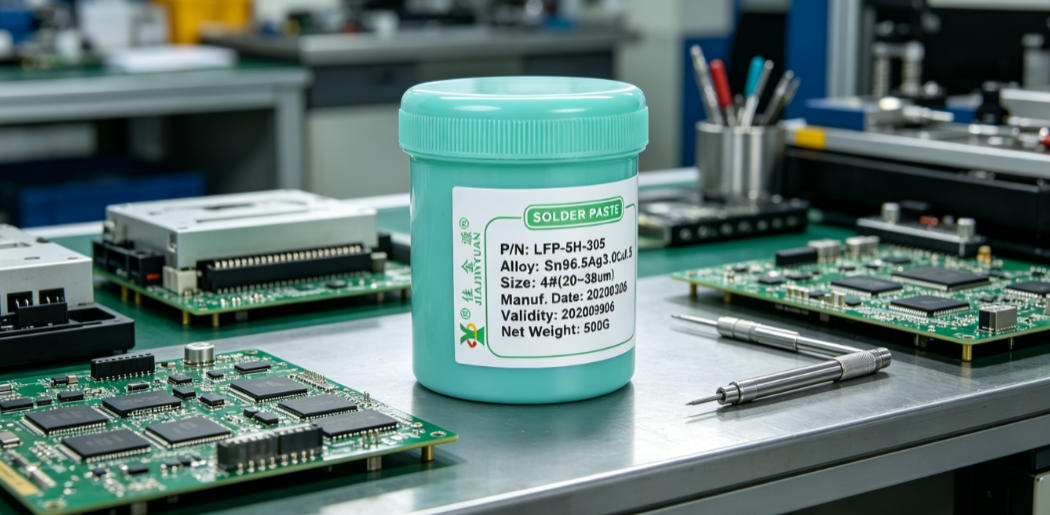
Solder paste stencil printing defects are a high-frequency failure in SMT production lines. Essentially, they occur when solder paste fails to transfer completely onto PCB pads. The root causes are often intertwined with stencil aperture accuracy, tension degradation, and the rheological properties of the solder paste. It is necessary to simultaneously inspect stencil wear status, squeegee pressure parameters, and changes in solder paste viscosity. Neglecting any of these aspects will lead to false yield fluctuations.
Published: 2010-05-16In the actual production line application of ISO solder materials, the melting point deviation between batches is controlled within ±1.2℃, and the fluctuation of active residue is less than 0.03%. This is attributed to Jia Jinyuan's decomposition of ISO 9001 clauses item by item into 27 executable actions, including smelting temperature recording frequency, alloy composition quick inspection response time, and packaging sealing sampling proportion, ensuring that each batch of ISO solder materials is fully controlled from feeding to outbound.
Published: 2010-04-26Cold solder joint is one of the most frequent soldering defects on SMT production lines. Its cause is often misjudged as insufficient solder paste activity, but in fact, it mostly stems from the deterioration of pad solderability combined with mismatched flux activity. By specifically improving the wetting ability of the pad surface, selecting JJY JY-602 medium-high activity no-clean flux, and strictly controlling the OSP film thickness and nitrogen purity, the cold solder joint rate can be reduced from 3.2‰ to below 0.4‰ without changing the reflow profile.
Published: 2010-04-22
Eco-friendly solder wire is not equivalent to RoHS compliance. It is necessary to confirm whether the content of six hazardous substances, including lead, mercury, and cadmium, is below the limit through a third-party test report. A supplier's verbal commitment or "lead-free" label alone cannot replace actual test data. Production lines often overlook batch differences, resulting in typical RoHS non-compliance symptoms such as dull solder joints and poor wetting after the entire batch of PCBs goes through the reflow oven.
Published: 2010-04-07Our technical team is always ready to provide professional solder material selection advice and SMT process solutions.