SMT Solder Paste Manufacturers.

Focused on SMT soldering processes, a one-stop electronic soldering solutions provider.

Here you can find knowledge about Solder Purity, including but not limited to usage methods, installation techniques, troubleshooting and more. Focused on SMT soldering processes. If you can't find what you need, please contact us anytime.
After multiple rounds of stirring, the viscosity of solder paste exhibits a non-linear trend of first decreasing and then increasing. In the initial stage, the shear action breaks the gel structure, enhancing the fluidity of the stirred solder paste. Continuous stirring, however, causes flux volatilization and agglomeration of metal particles, leading to an irreversible increase in solder paste viscosity. This pattern directly affects printing accuracy and the rate of missing prints.
Published: 2011-10-29Excess solder causes excessive solder paste on the bottom pads of BGA packages, which not only leads to surface defects such as solder ball splashing and bridging, but more importantly, significantly increases the probability of void formation. Especially in large-sized BGA devices, the void rate may exceed the 25% acceptable threshold specified in IPC-A-610E. Jiajinyuan's measured data shows that for every 0.02mm the solder paste thickness exceeds the standard value of 0.13mm, the average void area ratio increases by 7.3%. The root cause is that excessive solder paste obstructs the escape channels for flux gas during the reflow phase.
Published: 2011-10-10
When purchasing solder wires and solder filaments, key indicators such as alloy composition, tin content, flux activity, core diameter uniformity, and surface finish must be carefully verified. These parameters directly determine the wettability, void rate, and solder joint strength of SMT reflow soldering. If measured melting point deviation or core flux eccentricity is ignored during solder procurement, it can easily lead to high-frequency production line abnormalities such as solder bridging in wave soldering and cold solder joints in selective soldering.
Published: 2011-09-29The incompatibility of solder paste with PCBs featuring different surface finishes is a root cause o
Published: 2011-09-08In the ball mounting process, the size, shape and taper of stencil apertures directly affect the consistency of solder ball formation. Actual measurements by Jia Jinyuan show that 0.35mm circular apertures with 8° single-sided taper can keep the diameter fluctuation of over 95% of solder balls within ±0.015mm. Combined with the parameter set of squeegee pressure 0.3MPa and release speed 25mm/s, it significantly reduces defects such as missing balls and bridging balls.
Published: 2011-09-05Dip soldering is a core process for high-volume PCBA pin soldering. The composition, melting point, and oxidation control of wave soldering solder bars directly determine solder joint wettability and cold solder joint rate. Jia Jinyuan wave soldering solder bars can maintain a solder wave height deviation of ≤0.3 mm and a solder dross generation rate of less than 1.2% during 8 consecutive hours of production, significantly reducing fixture rework frequency.
Published: 2011-07-29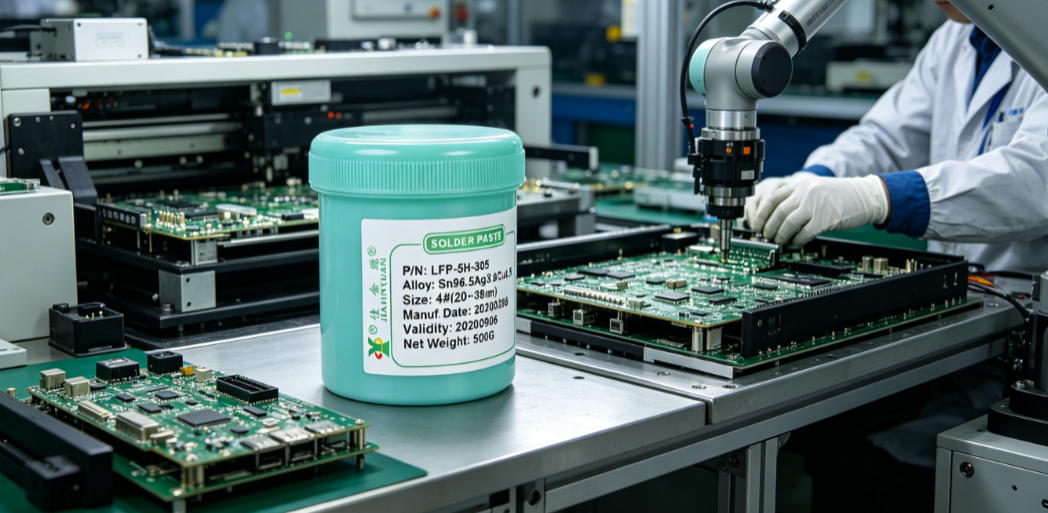
The shelf life of solder paste after opening is comprehensively affected by temperature, humidity, stirring frequency and exposure duration. Typically, under an environment of 20℃~25℃ and RH40%~60%, it can only maintain effective printability for 12~24 hours. Improper storage of solder paste will lead to increased viscosity, aggravated slump, and more solder balls. The production line needs to comprehensively determine whether the solder paste has failed based on changes in squeegee pressure, fluctuations in stencil printing defect rate, and abnormal wetting angle after reflow.
Published: 2011-07-17The volatilization rate of solder paste flux directly affects the wettability, void rate, and bridging risk of solder paste joints. Excessively fast volatilization can easily lead to insufficient solder paste collapse and cold solder joints, while excessively slow volatilization leaves residual flux that causes splashing and solder balls. Based on 20 years of practical SMT production line data from Jiajinyuan, this paper analyzes the cascading impact of the actual volatilization behavior of solder paste flux under different temperature zone settings on the formation of solder paste joints.
Published: 2011-07-15Jia Jinyuan provides free solder sample testing and sample mailing services. All solder sample tests are conducted synchronously on real SMT placement lines and wave soldering production lines, covering mainstream packages such as 0201 to QFN48. The measured yield data can be traced back to the furnace temperature curve and AOI original image of each batch. The solder sample test results are directly related to the customer's existing stencil opening, reflow soldering temperature setting and flux compatibility.
Published: 2011-06-14Circuit board soldering covers core processes such as SMT placement, wave soldering, and manual soldering, each of which imposes stringent requirements on solder paste printing accuracy, temperature profile control, flux selection, and PCB board deformation tolerance. Production line tests by Jia Jinyuan show that for 0.3mm pitch QFN devices, a reflow soldering peak temperature deviation exceeding ±2℃ causes cold solder joints, while insufficient wave soldering fixture press-in depth below 0.15mm leads to through-hole solder joint climb height falling below the 0.75mm standard value.
Published: 2011-05-22Our technical team is always ready to provide professional solder material selection advice and SMT process solutions.