SMT Solder Paste Manufacturers.

Focused on SMT soldering processes, a one-stop electronic soldering solutions provider.

Here you can find knowledge about Solder Quotation, including but not limited to usage methods, installation techniques, troubleshooting and more. Focused on SMT soldering processes. If you can't find what you need, please contact us anytime.
Fluctuations in the alloy composition of solder paste directly undermine its soldering stability, causing batch defects such as cold solder joints, bridging, and poor wetting. Especially in high-density placement scenarios like 0201 components and 0.4mm pitch QFN packages, even a ±0.05wt% deviation in the tin-silver-copper ratio of the alloy solder paste can lead to a drop of over 12% in post-reflow solder joint thrust. Therefore, continuous monitoring of solder paste quality is a critical line of defense to ensure the SMT first-pass yield.
Published: 2015-05-21The production of export wiring harness connectors must comply with the RoHS lead-free regulations, and connector solder must adopt compliant ratios such as Sn96.5/Ag3.0/Cu0.5. Jiajinyuan solder has stable wettability at a peak temperature of 245℃, and is compatible with terminal crimping and reflow soldering of multiple specifications with wire diameters ranging from 0.13 to 2.5mm. In mass production, the defect rates of solder balls, cold soldering, insufficient solder climbing and other defects are controlled within 800ppm.
Published: 2015-05-10Soldering of 01005 components is extremely sensitive to solder paste volume control, and the stencil thickness directly determines the solder paste printing volume. Jia Jinyuan's actual measurements show that a 0.1mm stencil can stably control the solder paste volume within the range of 120±15μm in 01005 component soldering. Excessive thickness easily leads to tombstoning and bridging, while insufficient thickness causes cold soldering and solder balls. Collaborative optimization combining aperture size and squeegee pressure is the key to production line implementation.
Published: 2015-04-21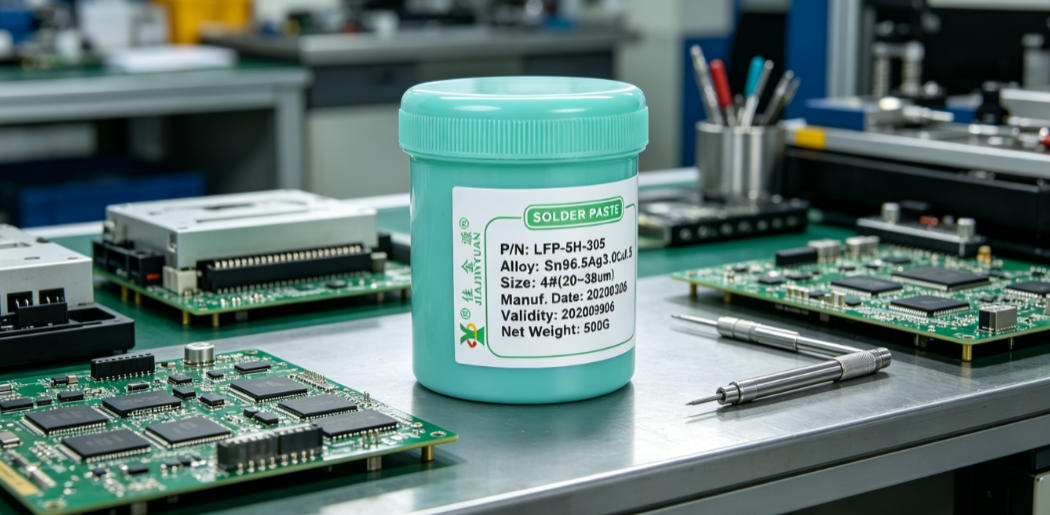
Solder paste slump is a typical defect after SMT printing where the edges of the solder paste spread outwards and its height decreases, resulting in solder joint bridging or cold solder joints. Its causes cover multiple factors such as solder paste rheological properties, stencil design, ambient temperature and humidity, and squeegee parameters. To prevent solder paste slump, it is necessary to start with solder paste selection, tightening the printing process window, optimizing stencil apertures, and real-time control of workshop temperature and humidity.
Published: 2015-04-17To address the failure risk of moisture-absorbed solder paste in the high-humidity environment of the solder paste workshop, this solution starts from three aspects: dynamic temperature and humidity monitoring, solder paste protection process reengineering, and shelf-life control after opening. It specifies 25℃/60%RH as the critical threshold, stipulates that solder paste must be used up within 4 hours after opening, and emphasizes the key role of coordinated adjustment of nitrogen-protected storage and squeegee pressure in reducing printing defects caused by moisture-absorbed solder paste.
Published: 2015-03-07
The cost difference between halogen-free solder paste and ordinary solder paste is concentrated in three aspects: raw materials, certification, and process adaptation. Halogen-free solder removes halogen elements such as bromine and chlorine, which leads to the reconstruction of the rosin system and increases the complexity of the flux formula by more than 30%. Coupled with certification costs such as REACH and IEC 61249-2-21, the per-kilogram purchase price is generally 28% to 45% higher than that of ordinary solder paste. However, reduced cleaning frequency, lower nitrogen consumption, and decreased rework rate during production line switching can partially offset this premium.
Published: 2015-02-22To address the persistent issues of solder paste and solder powder splashing and frequent tiny solder beads around small components on SMT production lines, this solution adopts a five-dimensional coordinated approach covering solder paste selection, stencil aperture design, squeegee parameters, printing pressure, and reflow soldering temperature profile. By adjusting solder paste viscosity and metal content to match the mounting requirements of 0201/01005-level components, and precisely controlling the peak reflow temperature of the solder paste within the range of 235±2℃, the measured solder bead defect rate has been reduced from 3200ppm to below 170ppm.
Published: 2015-02-16Manual soldering is a key process for repair soldering and rework on SMT production lines. Novices often cause defects such as cold solder joints and solder spikes due to improper temperature control, excessive solder joint dwell time, or incorrect selection of soldering tip types. Based on twenty years of practical experience on the Jiajinyuan production line, this paper focuses on pre-soldering preparation, soldering iron parameter setting, solder joint operation rhythm, and common defect attribution, directly addressing the core operational details that affect the first-pass yield.
Published: 2015-02-11When soldering precision sensor circuit boards with immersion silver boards, the excellent solder joint stability stems from the high density of the immersion silver layer, controllable interfacial reaction, and strong thermal cycle resistance. Jiajinyuan immersion silver boards have a measured thrust of over 85gf on 0.15mm fine-pitch BGA and 0.3mm pitch MEMS sensor pads, with an IMC thickness fluctuation of less than 0.12μm after reflow, significantly outperforming conventional OSP boards.
Published: 2015-01-17
The Jiajinyuan R&D team has been continuously optimizing the formulation system in response to solder performance bottlenecks, and has developed 12 major halogen-free and lead-free solder series covering the full temperature range of high, medium, low and ultra-low temperatures. Its domestic high-end solders have achieved breakthroughs in key indicators such as QFN/DFN solder wetting rate, low void rate for automotive lamps, and no solder balls in laser welding.
Published: 2015-01-08Our technical team is always ready to provide professional solder material selection advice and SMT process solutions.