SMT Solder Paste Manufacturers.

Focused on SMT soldering processes, a one-stop electronic soldering solutions provider.

Here you can find knowledge about Solder Paste Wholesale, including but not limited to usage methods, installation techniques, troubleshooting and more. Focused on SMT soldering processes. If you can't find what you need, please contact us anytime.

The melting point of lead-free solder wire is usually between 217°C and 227°C. During actual soldering, the soldering iron temperature should be set between 320°C and 360°C to compensate for heat loss and ensure wettability. Different wire diameters, flux contents, and PCB heat capacities significantly affect the optimal temperature setting. In production lines, real-time fine adjustments are often made through spike tests and solder joint gloss inspection.
Published: 2011-05-07FPC soldering has extremely stringent requirements for halogen residue, wettability, and residue insulation of solder paste. Jiajinyuan halogen-free solder paste strictly controls bromine and chlorine content below 900ppm, leaving no corrosive ion residue after reflow, while maintaining excellent slump resistance and 0.3mm fine-pitch printing stability. It has been successfully applied to high-end product lines exported to the EU, Japan, and South Korea, such as automotive camera modules and foldable screen hinge FPCs.
Published: 2011-04-25To address the challenge of cleaning residual stains on solder paste boards, it is necessary to simultaneously optimize solder paste selection and process parameters. While no-clean solder paste reduces cleaning pressure, it is more sensitive to stencil apertures and reflow environments. In contrast, traditional solder paste paired with cleaning requires chemical compatibility between the cleaning agent and solder paste residues. The cleaning effectiveness of solder paste is directly influenced by its metal content, rosin system, and activator type.
Published: 2011-04-17RoHS solder SGS testing certification is a mandatory threshold for export-oriented EU electronic assembly production lines. Jiajinyuan RoHS solder has passed SGS's full set of heavy metal and organic substance testing, with all six items—lead, cadmium, mercury, hexavalent chromium, polybrominated biphenyls, and polybrominated diphenyl ethers—meeting the standards. Customs clearance documents include the original SGS report, Declaration of Conformity, Material Safety Data Sheet, and batch factory inspection records, and the complete set of documents can be directly used for customs declaration and customer factory audits.
Published: 2011-04-11Loss of temperature and humidity control in the SMT printing workshop will cause fluctuations in solder paste viscosity, leading to defects such as insufficient solder, solder bridging, and misalignment. Jiajinyuan solder paste has the most stable viscosity under an environment of 22℃±2℃ and 45%RH±5%RH. When the temperature difference exceeds 3℃ or the humidity deviation exceeds 8%RH, the printing defect rate will rise. Process control must be achieved through closed-loop monitoring and zoned humidity control.
Published: 2011-03-20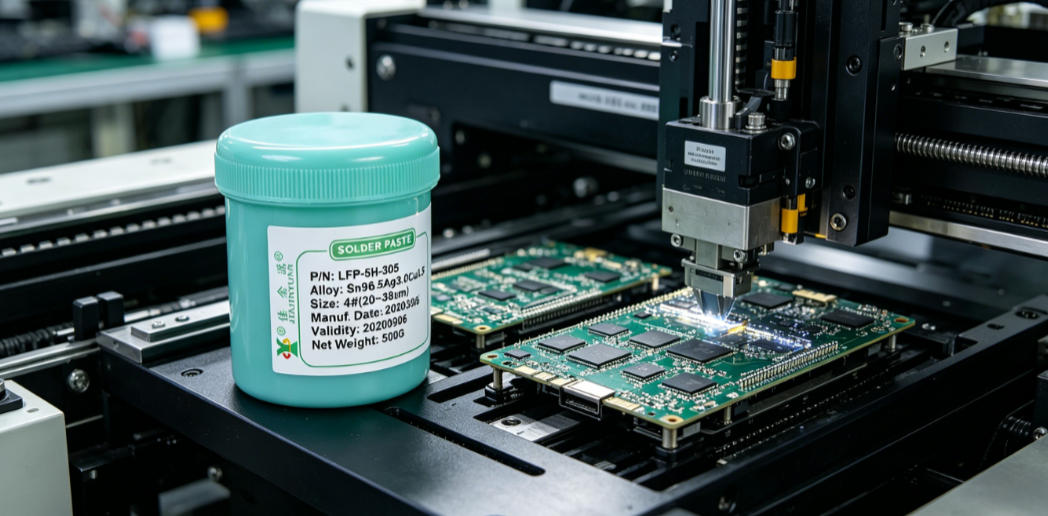
Solder paste, solder wire, and solder bar have clearly defined roles in SMT and manual soldering: solder paste is used for stencil printing of surface-mount components, solder wire is suitable for repair touch-up soldering and small-batch through-hole soldering, while solder bar is exclusively used in wave soldering machines. The three have essential differences in metal content, flux activity, melting point curve, and storage requirements, and selection must match the process path, equipment capability, and reliability level.
Published: 2011-03-10Domestic solder covers wire diameters from 0.3mm to 3.0mm, all temperature ranges (183℃~227℃) for both leaded and lead-free variants, and three flux systems: rosin, no-clean, and water-washable. It is compatible with multiple scenarios including high-speed SMT printing, wave soldering, dip soldering, and manual touch-up soldering. The Jiajinyuan series has a measured wetting angle ≤35°, bridging rate below 0.08%, and residual ion content <0.5μg/cm2. No adjustment to stencil apertures or reflow temperature profile is required when switching materials on the production line.
Published: 2011-03-06This article elaborates on the actual industry fluctuation logic of solder paste unit purchase price and minimum order quantity, explains the price composition in combination with different brands, metal contents and packaging specifications, clarifies that production line verification requirements and process parameters must be provided for solder paste sample applications, points out that the conventional solder paste procurement cycle is 5 to 12 working days, and urgent orders can be shortened to 3 days, but inventory and logistics routes must be confirmed simultaneously.
Published: 2011-02-23When performing rework soldering on FPC flexible boards, traditional solder paste requires a peak temperature above 235°C, which easily causes substrate blistering, copper foil peeling, or cover film cracking. In contrast, low-temperature solder paste reduces the reflow peak to 180°C ± 5°C, significantly lowering thermal stress while ensuring wetting, spreading, and solder joint strength. It is a key solder paste selection strategy that balances reliability and yield in precision rework of flexible printed circuits.
Published: 2011-02-15
Flux paste residue must be thoroughly removed with a matching solder cleaning agent; otherwise, it will lead to false ICT test results, corrosion of gold wire solder joints, or reduced adhesion of conformal coating. In actual production lines, isopropyl alcohol-based cleaning agents deliver consistent results for rosin-based flux paste but evaporate quickly; water-based cleaning agents are suitable for no-clean flux paste but require extended rinsing time; hydrocarbon-based cleaning agents have strong solvency for high-solid-content flux paste but carry the risk of swelling equipment seals.
Published: 2011-02-03Our technical team is always ready to provide professional solder material selection advice and SMT process solutions.