SMT Solder Paste Manufacturers.

Focused on SMT soldering processes, a one-stop electronic soldering solutions provider.

Here you can find knowledge about Solder Paste Alloy Powder, including but not limited to usage methods, installation techniques, troubleshooting and more. Focused on SMT soldering processes. If you can't find what you need, please contact us anytime.
Pin dip soldering uniformly covers the surface of component pins with a layer of tin-lead or lead-free solder, significantly improving pin solderability and wetting ability, and resolving cold solder joints and missed solder joints caused by plating oxidation and storage aging. It provides a stable and reliable soldering foundation for SMT placement, and is a key pre-treatment process for Jia Jinyuan's production line to handle high-density PCBs and fine-pitch QFP packages.
Published: 2013-10-14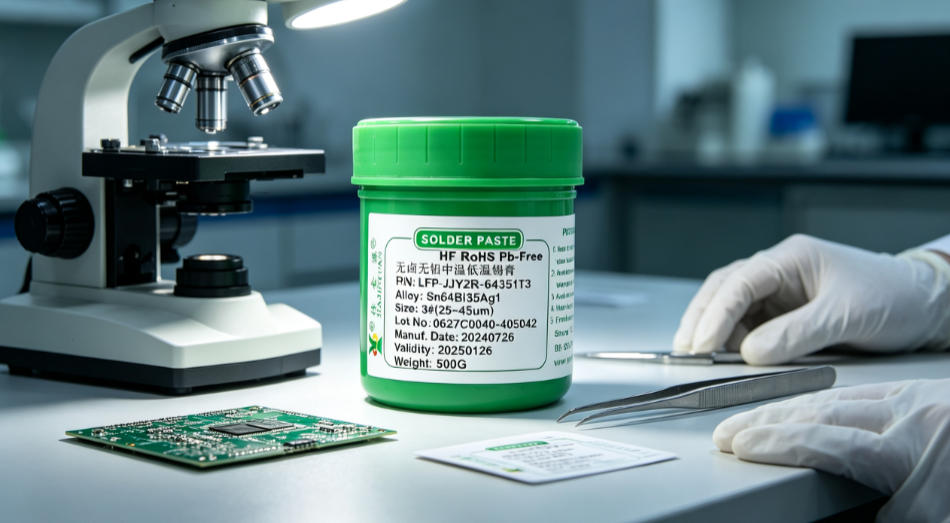
In BGA chip repair, the synergistic use of solder paste and flux paste directly affects ball mounting yield and soldering reliability. In actual production lines, the flux paste application amount and solder paste printing thickness must be dynamically adjusted based on chip size, solder ball diameter, and PCB pad oxidation level, to avoid pad corrosion caused by excessive activity or increased voids caused by insufficient activity.
Published: 2013-10-12Tearing is a typical defect in solder paste printing caused by poor rheological performance at the moment the squeegee separates from the stencil, manifesting as slender solder spikes at the edges of the pads, which directly affects subsequent placement accuracy and the risk of reflow soldering bridging. Jia Jinyuan's actual tests found that solder pastes with a thixotropic index below 0.65 or a yield stress below 85Pa are highly prone to tearing under conditions of a 30μm stencil and a 45° squeegee angle.
Published: 2013-09-28Soldering thick-copper PCBs places extremely high demands on solder paste rheology, wetting force, and anti-slump performance. During selection, practical production-line issues caused by thick copper—such as rapid heat dissipation, high pad thermal mass, and high tendency of printing misalignment—must be comprehensively considered. Priority should be given to thick-copper solder pastes with high metal content, low thixotropic index, and specially formulated active flux, to ensure sufficient wetting and reliable solder joint formation under conventional reflow profile conditions.
Published: 2013-09-16The full-process standardized control of ISO solder material production focuses on three major categories: solder paste, solder wire, and solder bar. Through hard measures such as raw material batch traceability, linked control of ambient temperature and humidity, closed-loop adjustment of the dual parameters of squeegee pressure and speed, and dynamic calibration of reflow profiles, the yield rate of Jia Jinyuan's production line is stably maintained above 99.2%, eliminating defects such as cold solder joints, solder bridging, and poor solder wetting caused by solder paste activity attenuation, metal content deviation, or flux precipitation.
Published: 2013-09-11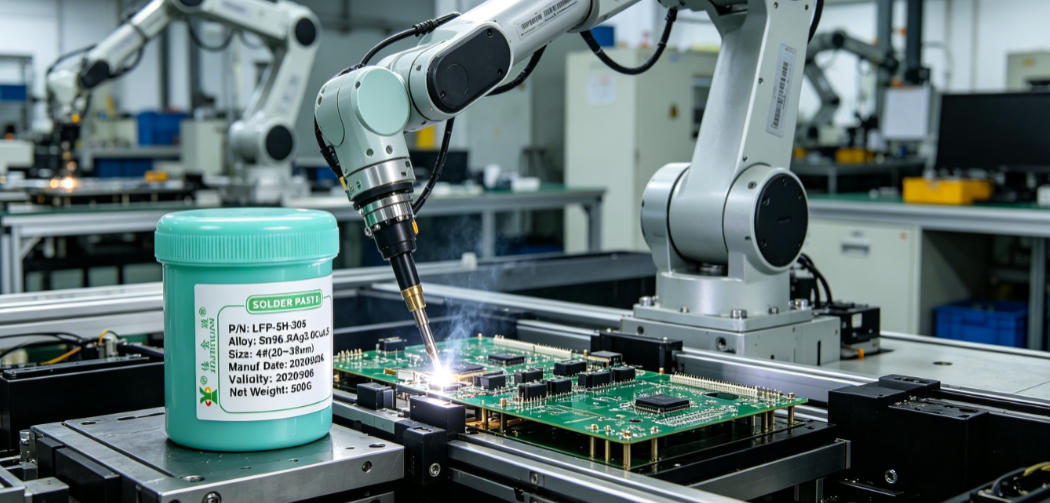
Silver-containing solder paste is irreplaceable in high-power LEDs, automotive-grade MCUs, and 5G RF modules due to its lower melting point, superior electrical and thermal conductivity, and thermal fatigue resistance. Although its silver content is only 0.3% to 3%, it can significantly improve solder joint reliability. Especially in frequent thermal cycling scenarios from -40°C to 150°C, the crack propagation rate of silver-containing solder is more than 40% lower than that of ordinary solder paste.
Published: 2013-08-28Lead-free and halogen-free solder options for electronics manufacturing have become mainstream. Jiajinyuan provides dual-system lead-free solders: Sn96.5Ag3.0Cu0.5 and Sn99.3Cu0.7, while also supporting halogen-free formulations with Br < 900 ppm and Cl < 900 ppm, meeting the full requirements of IEC 61249-2-21, JPCA-ES-01-2021, and RoHS3, and adapting to different product standards for consumer electronics, automotive electronics, and medical devices.
Published: 2013-08-12Excessive voiding in the bottom thermal pad during QFN soldering is a high-frequency failure point in production lines, rooted in improper solder paste volume control. Jia Jinyuan SG-880 series solder paste, used with a 0.15mm stencil aperture and 25℃ environmental temperature control, can reduce the void rate to below 8%. This solution has been continuously verified on the mass production line of automotive MCU modules for 6 months.
Published: 2013-07-18To meet the actual production line requirements for solder materials used in industrial control motherboards, this summary focuses on the compatibility issues of solder paste in SMT printing, reflow soldering and wave soldering processes, and elaborates on the synergistic performance of Jiajinyuan solder paste and matching solder bars in high-reliability soldering, covering key process parameters such as viscosity adaptation, metal content control, and residue corrosion inhibition.
Published: 2013-06-25Batch-to-batch color variation of solder paste is a high-frequency cause of production line abnormalities, often reflecting deviations in flux composition or differences in the oxidation level of metal powder, which directly affect the printability, slump behavior, and reflow wetting capability of solder paste, leading to concentrated outbreaks of defects such as cold solder joints, solder bridges, and solder balls. This effect is particularly pronounced in high-density mounting scenarios such as 0201 and 0.4mm pitch QFN.
Published: 2013-06-22Our technical team is always ready to provide professional solder material selection advice and SMT process solutions.