SMT Solder Paste Manufacturers.

Focused on SMT soldering processes, a one-stop electronic soldering solutions provider.

Here you can find knowledge about Solder Brands, including but not limited to usage methods, installation techniques, troubleshooting and more. Focused on SMT soldering processes. If you can't find what you need, please contact us anytime.
When manually soldering and repairing old PCBs, oxidized solder pads cause poor tinning and frequent cold solder joints. High-activity solder wire significantly improves the first-pass soldering success rate through stronger oxide film penetration and lower wetting temperature, and is especially suitable for manual soldering rework scenarios of communication boards and industrial control motherboards in service for over 8 years.
Published: 2021-06-22The solder paste sample evaluation verifies whether the sample solder paste meets the production line process window through practical test items such as printability, slump, viscosity, and wettability. The solder paste evaluation results directly determine the feasibility of batch introduction. All tests must be completed in a constant temperature and humidity environment to avoid temperature and humidity fluctuations interfering with the rheological properties and oxidation behavior of the solder paste.
Published: 2021-06-14Manual rework with eutectic solder offers a wide temperature window, fast wetting, and low voiding rate in actual production line operations. When paired with a constant-temperature soldering iron and a preheating platform, the peak temperature can be stably controlled at 183℃±5℃, significantly reducing the risks of BGA cold solder joints and PCB delamination, making it especially suitable for rapid-response scenarios involving small batches and multiple product varieties.
Published: 2021-06-08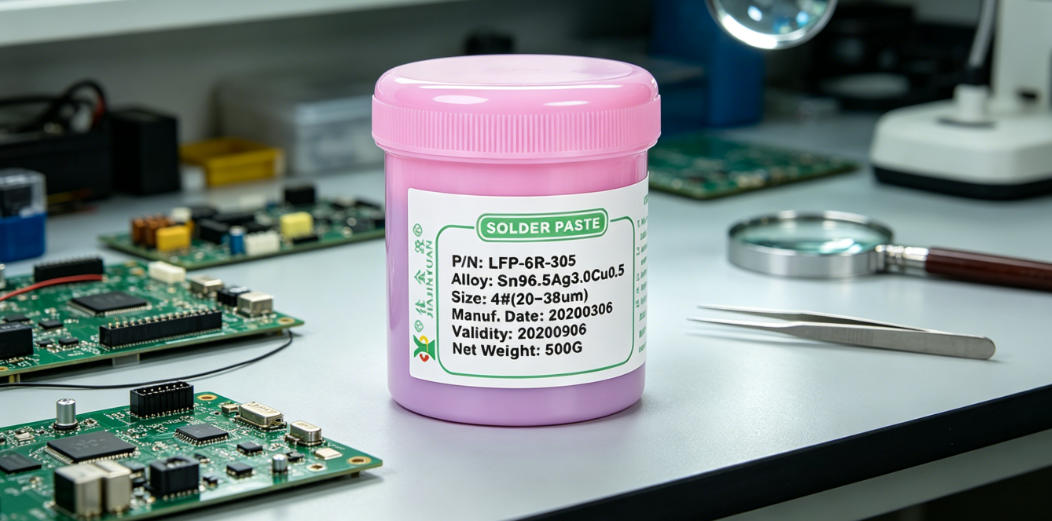
Although solder wires, solder bars and solder paste all belong to the lead-free solder system, differences in their forms lead to different design logics for alloy composition. In actual production lines, mixing them easily causes problems such as poor wettability, increased void rate and whitening residue after reflow soldering. The alloy ratios of the three cannot be simply interchanged; dedicated formulations matching the corresponding form must be selected according to process requirements.
Published: 2021-05-30Jiajinyuan has passed the ISO factory audit for solder materials and can provide authentic and valid ISO system certificates, covering production process control of the full range of products including solder paste, solder wire, and flux, ensuring that each batch of ISO solder materials meets the requirements of standards such as IPC-J-STD-005 and JIS Z3197, and satisfying the second-party audit needs of automotive electronics and medical equipment customers.
Published: 2021-05-24To meet the demand for solder exports for ASEAN foreign trade, Jia Jinyuan provides a full range of supporting supply solutions for solder paste, solder wire, and solder bars, covering the process windows of mainstream SMT production lines in Vietnam, Thailand, Malaysia, and other countries. The viscosity, metal content, and reflow activity of the solder paste have passed the dual verification of ASTM F2389-22 and JEDEC J-STD-005, ensuring stable printing and soldering for components ranging from 01005 to QFN48.
Published: 2021-05-10In multilayer PCB stack soldering, solder paste selection directly affects solder joint reliability and yield. It is necessary to comprehensively consider the melting point gradient, thixotropy matching, and flux residue characteristics of the stacked solder pastes. Especially when 0.3mm pitch BGA and fine-pitch QFN coexist, a dual-temperature-zone compatible solder paste must be selected, with the reflow peak temperature of the main solder paste at least 25°C higher than that of the underlying stacked solder paste, to avoid cold solder joints or solder balls caused by secondary reflow.
Published: 2021-04-30Welding thick copper boards directly determines the high-current carrying capacity and long-term operational stability of solder joints in new energy power boards. By optimizing the synergy among pad design, solder paste selection, and reflow profile, JJY ensures that solder joints on 2mm thick copper layers maintain a temperature rise within 35°C under a continuous current of 150A, avoiding common production line failures such as cold solder joints, excessive void rates, and thermal stress cracking.
Published: 2021-04-21PCBA soldering materials cover a full range of auxiliary materials including solder paste, solder wire, flux, cleaning agent and nitrogen. Their selection and control directly determine the SMT placement first-pass yield and long-term reliability. The Jiajinyuan series performs stably under stringent parameters such as reflow soldering peak temperature of 235℃±5℃, solder paste viscosity of 700±100Pa·s, and flux solid content of 18.5%.
Published: 2021-04-07When reflow soldering precision BGA/QFN devices, the heating rate directly affects solder joint void ratio, solder ball collapse consistency, and PCB warpage risk. In particular, a preheat ramp exceeding 3℃/s can easily cause ceramic substrate cracking, while insufficient flux residue control occurs when the soak stage duration below 150℃ is less than 90 seconds. Jia Jinyuan's measured data shows that the void ratio of QFN bottom solder joints increases by 27% as the heating slope rises by 1.2℃/s. The temperature difference across the entire board must be controlled within ±2.5℃ to ensure first-pass yield.
Published: 2021-03-25Our technical team is always ready to provide professional solder material selection advice and SMT process solutions.