SMT Solder Paste Manufacturers.

Focused on SMT soldering processes, a one-stop electronic soldering solutions provider.

Here you can find knowledge about Solder Bar Wholesale, including but not limited to usage methods, installation techniques, troubleshooting and more. Focused on SMT soldering processes. If you can't find what you need, please contact us anytime.
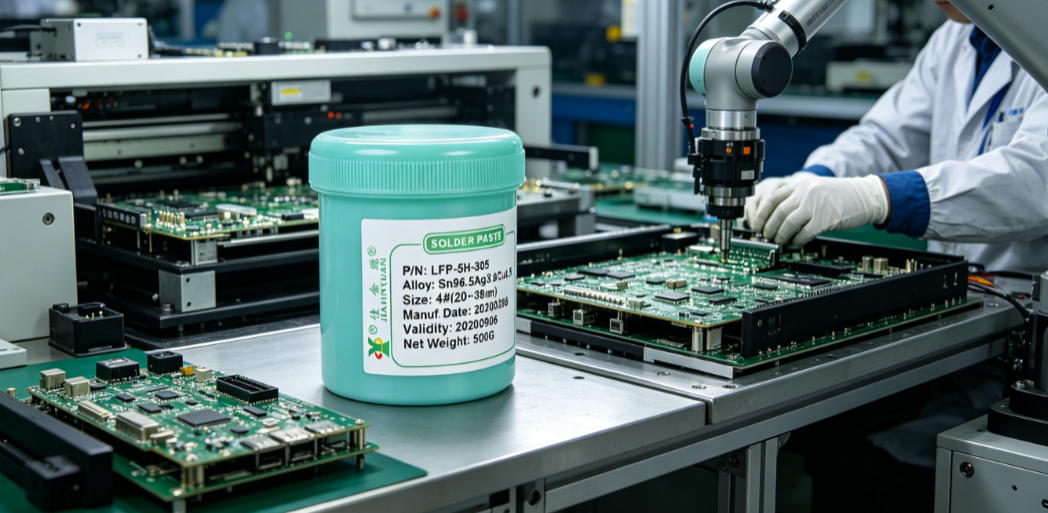
The design of solder paste stencil aperture openings directly affects the release performance of stencil printing and the forming quality of solder paste. Undersized apertures lead to insufficient solder paste volume and edge tearing, while oversized apertures easily cause bridging and slumping. Moreover, the aperture shape, wall roughness, and taper design alter the contact area and separation stress between the solder paste and the stencil. These factors are often overlooked in actual production lines, yet they directly determine the first-pass yield and SPI yield.
Published: 2014-12-18BGA soldering quality is highly dependent on the rheological properties and reflow behavior of solder paste. Low-void solder paste, by optimizing metal content, flux activity and particle distribution, significantly reduces solder joint void rate to below 3% in actual production lines, and has become a core material for improving BGA soldering first-pass yield and long-term reliability.
Published: 2014-12-05Solder manufacturers can provide OEM/ODM customized solder formula specifications to meet actual production line needs such as high reliability, lead-free soldering, and low-temperature soldering. As a solder manufacturer with 20 years of focus on SMT placement soldering, JJY has completed full-link customization for over 300 customers, covering alloy composition design, flux activity matching, and packaging forms, and supports fine-tuning verification of more than ten basic systems ranging from Sn96.5Ag3.0Cu0.5 to Sn42Bi58.
Published: 2014-11-24Ionic contamination of solder paste, decreased insulation resistance, and electrochemical migration are hidden yield killers in SMT production lines. Based on Jiajinyuan's 20 years of practical experience in third-party solder paste testing, this paper analyzes the migration pathways of halogen residues, organic acid activators, and metal ions in flux solder paste under temperature and humidity environments, and identifies failure precursor features that conventional solder paste testing cannot cover.
Published: 2014-11-20OSP board soldering is a critical process in SMT production lines that is highly prone to cold solder joints, poor wetting, and pad oxidation failures. It is necessary to optimize stencil aperture design, solder paste selection, reflow profile, and first-article verification process in response to the thermal sensitivity, thin-layer characteristics, and weak adhesion to the copper substrate of the OSP anti-oxidation protective film. Otherwise, even if the placement accuracy meets the standards, batch issues such as dull solder joints, insufficient solder climb height, or abnormal ICT test impedance will occur after reflow.
Published: 2014-11-10The solder used in energy storage modules directly determines the welding reliability of energy storage power supply protection boards and inverters. Jiajinyuan solder exhibits no cracks, low void rate, and an interface IMC thickness controlled at 3.2±0.4μm in 125℃ high-temperature cycle tests, and its wetting and spreading consistency on copper substrates and nickel-plated terminals is superior to that of common industry-standard tin-silver-copper systems.
Published: 2014-10-21The pressure adjustment of the squeegee for solder paste printing directly affects the solder paste forming quality. Excessive pressure will cause solder paste collapse, solder spikes or leakage under the stencil, while insufficient pressure will lead to insufficient solder volume, jagged edges or local missing printing. Combined with the rheological properties of printing solder paste and solder paste parameters such as viscosity, metal content and thixotropic index, on-site fine-tuning within the range of 50~120N is required, while simultaneously observing the stencil rebound status, squeegee trailing marks and pad filling completeness.
Published: 2014-10-12SMT defects are a high-frequency source of failures on production lines. Typical issues such as solder balls, voids, tombstoning, and bridging are directly related to printing accuracy, reflow profile, and component coplanarity. Jia Jinyuan production line data shows that 83% of SMT defects stem from solder paste volume deviation exceeding ±15% or improper matching between stencil apertures and PADs.
Published: 2014-09-14Leveraging its solder ODM R&D capabilities, JJY has developed solder pastes and preformed solder sheets with low voiding rate, zero halogen, and high-temperature reflow resistance for scenarios such as medical equipment, new energy vehicle electronic control, and high-reliability industrial modules. Their solder joint thrust reaches over 85MPa, and the IMC layer thickness is controlled within the range of 1.2~1.8μm, meeting the dual certification requirements of ISO 13485 and AEC-Q200.
Published: 2014-09-13
The oxidation resistance of solder bars and the amount of tin dross generated are highly dependent on the alloy composition. The Sn99.0Ag0.3Cu0.7 eutectic solder bar containing 0.3% silver and 0.7% copper exhibits a 40% improvement in oxide film compactness during wave soldering at 250°C, with a measured tin dross rate 65% lower than that of pure tin. While adding trace amounts of nickel or germanium can refine the grain structure, it tends to cause spattering. Production line verification shows that its overall stability is inferior to that of the classic ternary formulation.
Published: 2014-09-08Our technical team is always ready to provide professional solder material selection advice and SMT process solutions.