SMT Solder Paste Manufacturers.

Focused on SMT soldering processes, a one-stop electronic soldering solutions provider.

Here you can find knowledge about Tin Ingot, including but not limited to usage methods, installation techniques, troubleshooting and more. Focused on SMT soldering processes. If you can't find what you need, please contact us anytime.

Improper storage of solder paste will lead to reduced activity of SMT solder paste, segregation of metal content, and imbalance in solvent volatilization. Continuing to use it for soldering on the production line can easily cause defects such as cold solder joints, tombstoning, solder balls, and bridging, and in severe cases, lead to functional failure of the entire batch of PCBA. Based on 20 years of practical experience in SMT production lines, this article directly addresses the typical risk points of the disconnect between solder paste storage and usage.
Published: 2026-08-27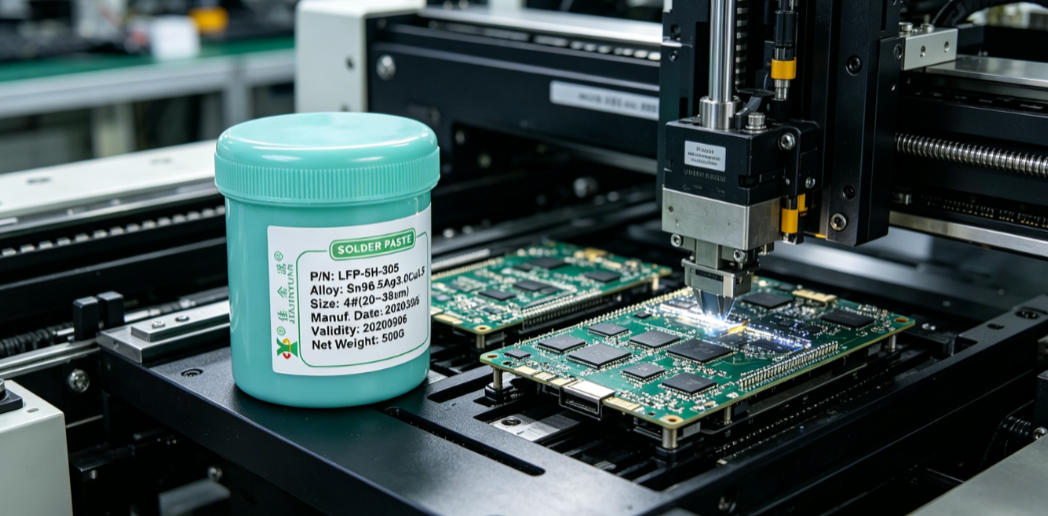
An excessively large ramp-up slope during reflow soldering can easily cause typical solder paste defects such as solder paste splashing, solder balls, tombstoning, and poor wetting. The root causes are violent vaporization of the flux, accelerated oxidation of solder powder, and unbalanced thermal stress on components. Production lines should address this by stepwise optimizing the preheat zone slope, calibrating thermocouple positions, shortening the soaking time, and strengthening cold storage management for solder paste.
Published: 2026-08-27
The size, shape, and wall roughness of SMT stencil apertures directly affect the paste filling, release, and pad coverage during solder paste printing. Improper design can lead to typical defects such as solder bridging, insufficient solder, and misalignment. Based on real production line failure cases, this paper reveals five high-frequency misconceptions, including improper aperture ratio, excessive inverse trapezoid, and unprocessed edge burrs, along with their root-cause solutions.
Published: 2026-08-27
Poor soldering performance on manual solder wires is mostly caused by the imbalance between flux activity and residue. When selecting a flux, focus on four hard parameters: rosin-based proportion, halogen content, activation temperature, and spreadability. A chloride ion content of 0.5%~1.2%, an activation range of 180℃~220℃, and a spreadability of over 92% are the key thresholds for a reliable manual solder wire flux.
Published: 2026-08-27
Solder paste slump after printing directly affects component placement accuracy and reflow soldering quality. The main causes include low solder paste viscosity, improper stencil aperture design, excessive squeegee pressure, and uncontrolled ambient temperature and humidity. Typical manifestations include blurred edges, bridging, or height drop exceeding 15% within 30 seconds after printing. Systematic troubleshooting should be conducted in combination with practical parameters such as viscosity of 750–950 Pa·s, squeegee angle of 55°–62°, and release speed of 25–40 mm/s.
Published: 2026-08-27
For the selection of solder wire and solder bar alloys for equipment operating in high-temperature environments, this article directly addresses the real pain points of SMT production lines. Focusing on five core issues: melting point matching, thermal fatigue resistance, wettability degradation, flux residue corrosion, and oxide film suppression, it provides immediately actionable troubleshooting paths and process adjustment measures. All solutions are validated by 20 years of on-site commissioning data, with no theoretical explanations—only practical guidance.
Published: 2026-08-27
Tight global tin ore supply is driving the development of the solder recycling and reuse industry, and the proportion of secondary tin in solder raw materials is steadily increasing.
Published: 2026-08-24
The China-US trade friction has intensified price fluctuations in solder raw materials, and the volatile prices of key metals such as tin and silver have affected cost control for solder manufacturers.
Published: 2026-08-24There are significant differences in solder paste printing adaptability, which are closely related to machine parameters, operating specifications and solder paste characteristics. Reasonably adjusting equipment parameters and optimizing the process flow can significantly improve the printing effect.
Published: 2026-08-24
The application penetration rate of halogen-free solder paste in electronic manufacturing continues to increase, making it the preferred soldering material for high-reliability electronic products.
Published: 2026-08-24Our technical team is always ready to provide professional solder material selection advice and SMT process solutions.