SMT Solder Paste Manufacturers.

Focused on SMT soldering processes, a one-stop electronic soldering solutions provider.

Here you can find knowledge about Solder Paste Production, including but not limited to usage methods, installation techniques, troubleshooting and more. Focused on SMT soldering processes. If you can't find what you need, please contact us anytime.
Cold soldering problems often stem from the fact that the actual peak temperature of the reflow oven fails to reach the solder paste activity window. Production line verification by Jiajinyuan shows that conducting oven temperature tests at least once a week can stably control the cold soldering defect rate within 300ppm. The fluctuation range of each temperature zone is measured using a KIC temperature profiler to ensure sufficient solder paste melting and that the thickness of the intermetallic compound (IMC) layer meets the standard.
Published: 2009-06-07SMT solder paste selection must closely align with the actual pain points of the production line. Domestic solder pastes vary significantly in QFN solder wetting rate, halogen residue, void control, and laser welding compatibility. The 8MQP/5RQ series achieves nearly 100% solder wetting, the 8M9P/5RR zero-halogen variant matches the high-heat scenarios of automotive lighting, and the water-washable 8MW5/5RW5 meets the welding needs of both stainless steel and aluminum materials. The alloy powder grade (T3-T7), halogen grade (ROL0 to ROL1), and temperature window of placement solder paste must be strictly matched with equipment capabilities and product reliability requirements.
Published: 2009-06-04Based on production line measurements, this paper compares the performance of domestic no-clean solder paste in terms of QNP solder wetting rate, halogen residue, void control, and printing stability. It focuses on analyzing the process adaptability of three JIAJINYUAN SMT solder pastes—8MQP/5RQ, 8MNTTP/5RNTT, and 8M9P/5RR—on high-precision communication boards and automotive lighting boards, providing reproducible parameter references for the selection of domestic solder paste.
Published: 2009-06-02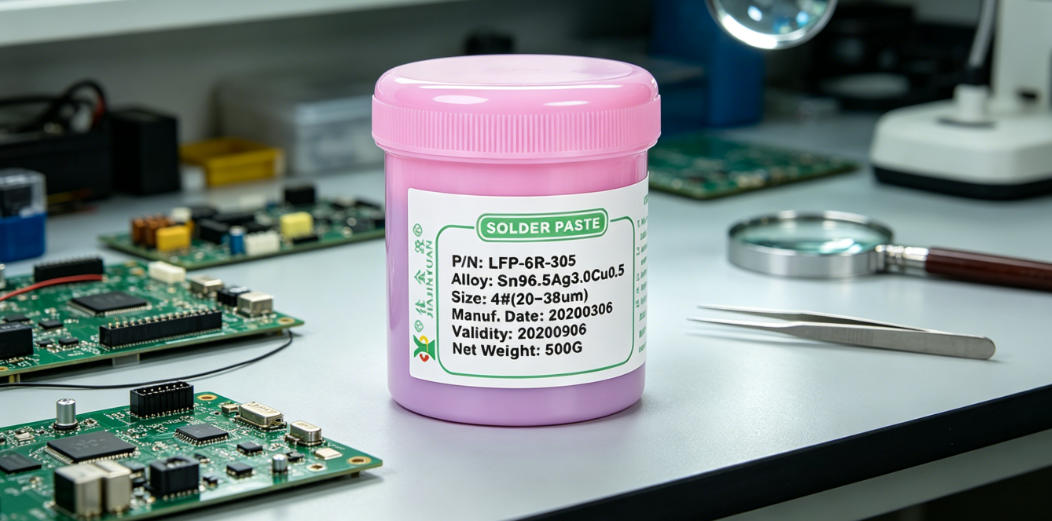
The proportion of flux in solder paste is usually controlled between 8% and 12%. This range can not only ensure the viscosity and release performance during printing, but also meet the dual requirements of active release and controllable residue during the reflow stage. Too high a proportion can easily lead to slump and splashing, while too low a proportion can cause poor wetting and cold soldering. The actual production line needs to be dynamically fine-tuned in combination with stencil apertures, ambient temperature and humidity, and reflow oven capabilities.
Published: 2009-06-02To address persistent production-line issues such as excessive voiding, poor solder climbing, and residual whitening in high-precision PCB assembly, this paper directly examines the measured performance of 8M9P/5RR zero-halogen low-void solder paste and 8MNTTP/5RNTT ultra-low-residue domestic solder paste. Combined with QFN device soldering, communication module rework, and automotive LED thermal management scenarios, it explains how low-void solder paste achieves a void rate of <3% through 0ppm halogen control, T4-grade fine powder distribution, and 305 alloy melting point matching, while also balancing PCB solder paste printing accuracy and batch stability of domestic solder paste.
Published: 2009-05-31The selection of low-temperature solder paste must closely align with the balance among the temperature resistance limit of devices, solder joint reliability, and the production line process window. Among domestic solder pastes, LFP-JJY2R-64351 (Sn64Bi35Ag1), LFP-JJY5RW1A-4258 (Sn42Bi58), and LFP-JJY5RG-In52Sn48 have been batch-verified in scenarios such as LED transparent displays, copper wire lights, and fingerprint locks. Combined with T3/T4 powder particle sizes and ROL1/ROL0 halogen control, they achieve a solder wetting rate of over 70%, a void rate of <8%, and transparent, non-corrosive residues within a 160–220℃ reflow window.
Published: 2009-05-29This paper focuses on the actual selection logic of high-temperature solder paste among domestic solder paste brands, combining 12 series of parameters verified by first-tier production lines such as Jia Jinyuan, covering QFN solder wetting rate, halogen content, alloy powder type, and the reflow soldering temperature window for solder paste. It particularly emphasizes the stability performance of 0307/305 alloys under the 240–260℃ reflow soldering process for solder paste.
Published: 2009-05-27For the frequently occurring solder bead defects on SMT production lines, starting from three aspects: stencil aperture optimization, adjustment of solder paste metal content and particle size distribution, and coordinated control of reflow soldering ramp rate and peak temperature, a directly implementable solder bead improvement plan is proposed, emphasizing the balance between solder paste printing ductility and splash suppression during reflow.
Published: 2009-05-26Halogen-free solder paste must balance ROHS compliance and solder wetting reliability in high-precision electronic assembly. The 8MQP/5RQ series launched by domestic solder paste manufacturer Jia Jinyuan has individual halogen content <900ppm and a solder wetting rate close to 100%. The 8MNTTP/5RNTT series has halogen content as low as 100~200ppm with transparent residue. Paired with T3-T5 alloy powders such as 0307/305, it has been verified to stably pass ROHS solder paste certification requirements in the mass production of QFN/DFN devices and communication terminals.
Published: 2009-05-25To address pain points such as prolonged printing without drying, solder paste slump, and poor solder wetting on SMT production lines, this domestically produced solder paste uses a rosin-based formula combined with 0307/T4 alloy powder. Within a reflow window of 240–255℃, it achieves nearly 100% solder wetting rate for QFN/DFN packages, with a halogen content below 900ppm and transparent residue. It balances printing stability and soldering reliability, making it a cost-effective choice as an alternative to imported printing solder paste, SMT solder paste, and domestic solder paste.
Published: 2009-05-23Our technical team is always ready to provide professional solder material selection advice and SMT process solutions.