SMT Solder Paste Manufacturers.

Focused on SMT soldering processes, a one-stop electronic soldering solutions provider.

Here you can find knowledge about Solder Ball Reduction, including but not limited to usage methods, installation techniques, troubleshooting and more. Focused on SMT soldering processes. If you can't find what you need, please contact us anytime.
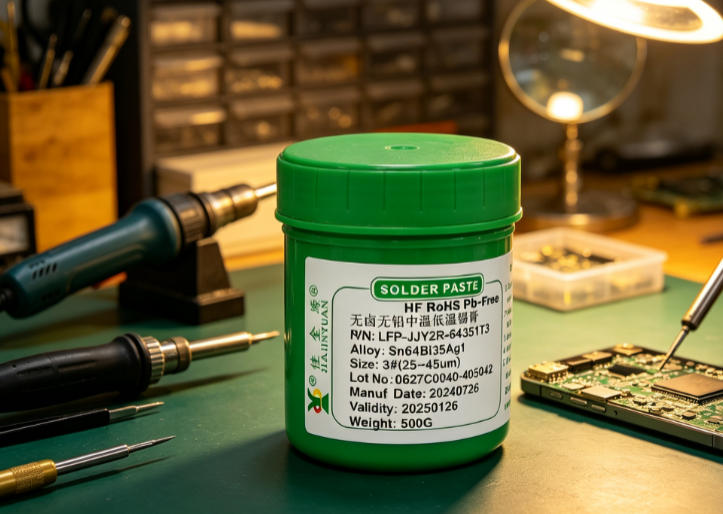
Solder paste delamination is a phase separation phenomenon between solder powder and flux caused by density differences or improper storage, manifesting as a clear oily substance on the upper layer and particle deposition on the lower layer. In this state, the printing accuracy of the solder paste decreases and the risk of slump increases, so it must be discontinued and re-stirred or scrapped.
Published: 2017-04-05The solder used in energy storage modules is extremely sensitive to voiding rate. Low-void solder paste can control the voiding rate of BGA solder joints within 5%, significantly improving the thermal fatigue life of electronic control boards under high-power cycling. Jiajinyuan JY-810A solder paste, with its stable thixotropy, low residue, and reflow wetting angle of less than 25°, has become a practical combination for BGA soldering of electronic control boards in the selection of solder materials for energy storage modules.
Published: 2017-04-04SMT placement pressure control directly affects the deformation state of solder paste. Excessive pressure will cause the solder paste to be squeezed laterally to both sides of the pad, leading to bridging defects. JIAJINYUAN placement machines achieve ±0.02N precision control through real-time pressure feedback and Z-axis dynamic compensation, combined with stencil aperture design matched with the rheological properties of solder paste, to suppress bridging from the source.
Published: 2017-03-09The solder joint cracking rate of FPC soldered flexible screen modules under repeated bending scenarios is significantly reduced. The key lies in optimizing the solder paste printing accuracy, matching the reflow soldering temperature profile to the thermal expansion characteristics of the FPC substrate, and strictly controlling the FPC mounting offset and Z-axis pressure. Jiajinyuan's actual measurement shows that the cracking rate after 200,000 bending cycles is less than 0.3%, which is far better than the industry's conventional level of 0.8%.
Published: 2017-02-14Improper sealing of refrigerated solder paste will accelerate solder paste oxidation, leading to poor printing release, increased solder joint void rate, and insufficient wetting after reflow. Especially in high-temperature and high-humidity seasons, the surface of unsealed refrigerated solder paste is prone to forming a gray-black oxide film, which directly affects the first pass yield of the SMT production line. Therefore, standardizing the sealing management of refrigerated solder paste is a key link in controlling solder paste oxidation.
Published: 2017-02-05
The blackening of solder wire solder joints is neither a simple solder wire quality issue nor caused solely by temperature runaway, but rather the result of multiple interwoven factors such as oxidation of flux residues, improper matching of soldering temperature and time, attenuation of active components in the solder wire, and deterioration of PCB pad solderability. Especially under high-load conditions such as wave soldering or manual soldering, solder joint blackening often reveals the process coupling problem of excessively high halogen content in the solder wire and chain oxidation reactions.
Published: 2017-01-16Cold solder joints are almost impossible to identify visually with the naked eye or via conventional AOI, and must be exposed through power-on testing and thermal stress excitation. Their essence is the absence of continuous metallurgical bonding between the solder joint metals, leading to signal transmission interruption, abnormal temperature rise, and intermittent failures. Statistics from the JJY production line show that 73% of customer returns caused by cold solder joints occur after 48 hours of complete machine aging.
Published: 2017-01-15Jiajinyuan PCBA soldering materials are specifically designed for new energy battery management system BMS boards, photovoltaic inverter control boards, and industrial PLC main control boards. Its low-void-rate solder paste maintains a stable void area of less than 12% after reflow in 0.3mm fine-pitch QFN packages, which can be further reduced to 8.5% with a nitrogen atmosphere, meeting the stringent requirements of automotive-grade AEC-Q200 for solder joint reliability.
Published: 2016-12-27High-frequency PCB soldering is extremely sensitive to the halogen content and residue control of solder paste. Jiajinyuan halogen-free low-residue solder paste, by optimizing the rosin system and activator ratio, ensures wettability while reducing ionic contamination to below 0.25μg/cm2, significantly minimizing impedance fluctuations and phase shifts in high-frequency signal transmission.
Published: 2016-12-13
Cold solder joints caused by solder wire are a high-frequency root cause of failures on SMT production lines. They are neither a simple material defect nor a single process control failure, but rather the result of coupled mismatches among multiple variables, including solder wire activity, wire diameter tolerance, flux residue, soldering iron temperature, wire feed rhythm, and solder joint wetting time. Typical manifestations include a dull solder joint surface without metallic luster, a thrust test result below 50gf, and an internal void rate exceeding 15% visible under X-ray inspection.
Published: 2016-12-07Our technical team is always ready to provide professional solder material selection advice and SMT process solutions.