SMT Solder Paste Manufacturers.

Focused on SMT soldering processes, a one-stop electronic soldering solutions provider.

Here you can find knowledge about Solder Storage Conditions, including but not limited to usage methods, installation techniques, troubleshooting and more. Focused on SMT soldering processes. If you can't find what you need, please contact us anytime.

Prolonged high-temperature operation of solder bars in a wave soldering furnace can indeed cause micro-segregation of alloy components. Particularly when tin-lead or lead-free solder bars are continuously exposed to temperatures above 260°C with insufficient bath surface agitation, elements such as lead, silver, and copper may locally enrich due to differences in density and oxidation rate. However, within the standard 8-hour solder replacement cycle, compositional variations remain well below the tolerances permitted by IPC-J-STD-006. What truly affects soldering stability is often the accumulation of dross and carbonized flux residues.
Published: 2015-10-14High-frequency board welding imposes extremely high requirements on the thermal sensitivity of the substrate. Materials such as PTFE and ceramic-filled PP generally have a glass transition temperature below 170°C. If the peak reflow temperature exceeds 260°C, it can easily cause delamination, blistering, or dielectric constant drift. Actual measurements on Jiajinyuan's production line show that 255°C is the safe threshold for most high-frequency board welding. Thermal damage must be avoided through stepwise heating, reducing residence time in the high-temperature zone, and nitrogen atmosphere control.
Published: 2015-10-08Pre-tinning OSP pads places extremely high demands on the wettability of solder paste. Low-residue, highly active, and highly penetrating OSP solder paste must be selected; otherwise, cold solder joints, tombstoning, and poor wetting are likely to occur. In actual production lines, common problems mostly stem from insufficient reaction between the solder paste and the OSP coating, failure of the flux to break through the coating in time during reflow, or printing misalignment caused by a mismatch between the metal content and viscosity of the solder paste.
Published: 2015-09-13The no-clean and water-washable formulations for PCBA soldering materials need to balance ionic residue control and post-soldering surface cleanliness. The Jiajinyuan series formulations achieve stable performance with rosin-based residue <0.5μg/cm2 and halogen content <0.1wt% in actual production lines, meeting the process requirements for high-density PCBA soldering materials for 01005 components and 0.3mm pitch BGA.
Published: 2015-09-05Automotive electronic solder must meet the long-term reliability requirements of vehicle-mounted circuit boards under high-temperature, high-humidity, and strong-vibration environments. Jiajinyuan automotive electronic solder adopts a low-silver lead-free formula, delivers stable wettability at a peak reflow temperature of 260℃, controls the IMC layer thickness within the range of 3.2~4.8μm, effectively suppresses solder joint crack propagation, has obtained AEC-Q200 certification, and is used in mass production on ADAS domain controller PCBA production lines.
Published: 2015-08-30AOI inspection uses high-precision optical imaging and intelligent algorithms to identify typical SMT soldering defects such as insufficient solder, excessive solder, bridging, and component misalignment in real time. It has been stably applied in Jia Jinyuan's production lines for full-type PCB inspection of packages ranging from 0201 to QFN48, reducing the false negative rate of manual visual inspection from 12% to within 0.8%, significantly improving first-pass yield and shortening the FA analysis cycle.
Published: 2015-08-16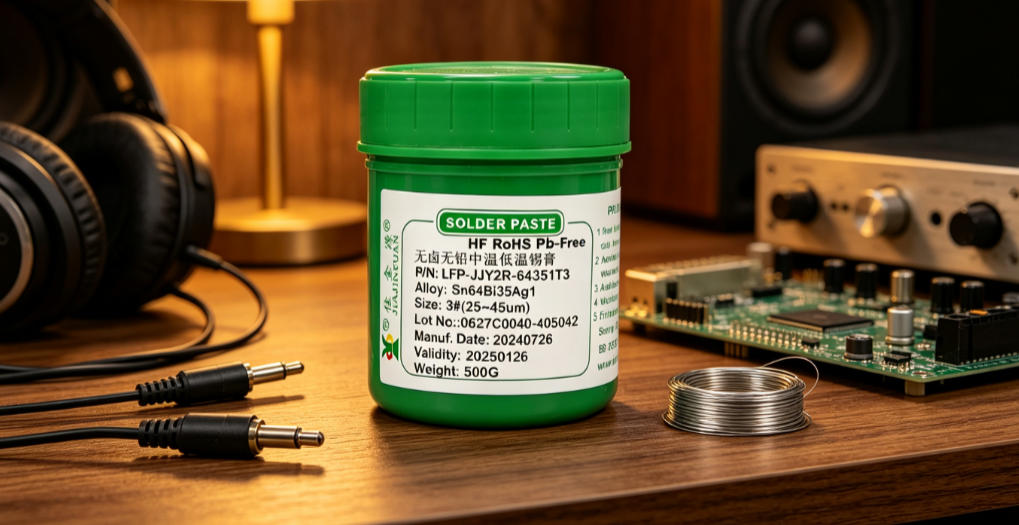
When changing solder paste brands during SMT production, a strict SMT verification process must be implemented, covering multi-dimensional tests such as printability, mountability, reflow performance, and solder joint reliability. The focus is on monitoring changes in solder paste viscosity, stencil life attenuation, and the incidence of solder balls and bridging, to avoid batch cold solder joints or tombstoning defects caused by batch switching.
Published: 2015-08-09Rework soldering is a critical process in PCBA repair that demands extremely high precision and thermal control. This paper focuses on the full process of desoldering and replacing chips such as BGA and QFN, covering hot air gun parameter setting, stencil aperture matching, solder paste selection, and key points of post-soldering X-ray inspection. All parameters are derived from measured data on the JJY production line, emphasizing the coordinated control of temperature curve gradients, nozzle vacuum values, and PCB delamination risks.
Published: 2015-07-12The standard for repeated refrigeration, thawing and reuse of solder paste and the scrap judgment are directly related to the yield and cost of SMT production lines. Based on 20 years of measured production line data from JJY, this paper clarifies that under the refrigeration condition of 4±2℃, solder paste is allowed to be reused for no more than 3 times after thawing, the effective service time after each thawing is 24 hours, and the solder paste will be scrapped when it is exposed to room temperature for more than 72 hours in total. It also points out that the solder paste must be stopped immediately when the viscosity rebound exceeds 15%, the metal content drops by more than 0.8%, or the flux stratification is obvious.
Published: 2015-06-26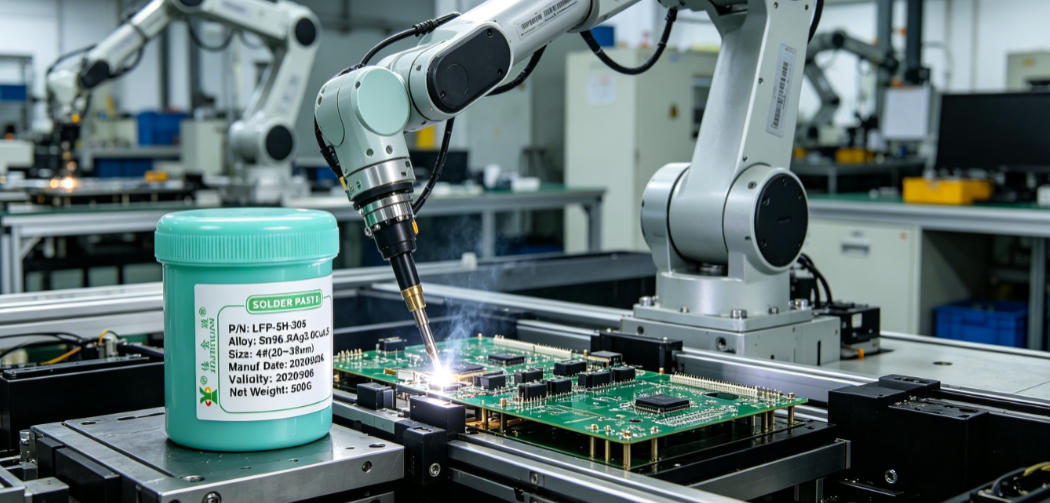
SMT solder paste must be stored refrigerated to inhibit oxidation of the metal powder and chemical reactions of the flux, preventing increased viscosity, aggravated slump, and reduced printing accuracy. The warm-up procedure must strictly follow the process of 4 hours of standing at room temperature followed by 2 hours of stirring, to avoid splashing and cold solder joints caused by condensation water contamination. This is a critical step that production line engineers must not skip before starting work each day.
Published: 2015-06-05Our technical team is always ready to provide professional solder material selection advice and SMT process solutions.