SMT Solder Paste Manufacturers.

Focused on SMT soldering processes, a one-stop electronic soldering solutions provider.

Here you can find knowledge about Solder Paste Flux, including but not limited to usage methods, installation techniques, troubleshooting and more. Focused on SMT soldering processes. If you can't find what you need, please contact us anytime.
The no-clean and water-washable formulations for PCBA soldering materials need to balance ionic residue control and post-soldering surface cleanliness. The Jiajinyuan series formulations achieve stable performance with rosin-based residue <0.5μg/cm2 and halogen content <0.1wt% in actual production lines, meeting the process requirements for high-density PCBA soldering materials for 01005 components and 0.3mm pitch BGA.
Published: 2015-09-05Automotive electronic solder must meet the long-term reliability requirements of vehicle-mounted circuit boards under high-temperature, high-humidity, and strong-vibration environments. Jiajinyuan automotive electronic solder adopts a low-silver lead-free formula, delivers stable wettability at a peak reflow temperature of 260℃, controls the IMC layer thickness within the range of 3.2~4.8μm, effectively suppresses solder joint crack propagation, has obtained AEC-Q200 certification, and is used in mass production on ADAS domain controller PCBA production lines.
Published: 2015-08-30AOI inspection uses high-precision optical imaging and intelligent algorithms to identify typical SMT soldering defects such as insufficient solder, excessive solder, bridging, and component misalignment in real time. It has been stably applied in Jia Jinyuan's production lines for full-type PCB inspection of packages ranging from 0201 to QFN48, reducing the false negative rate of manual visual inspection from 12% to within 0.8%, significantly improving first-pass yield and shortening the FA analysis cycle.
Published: 2015-08-16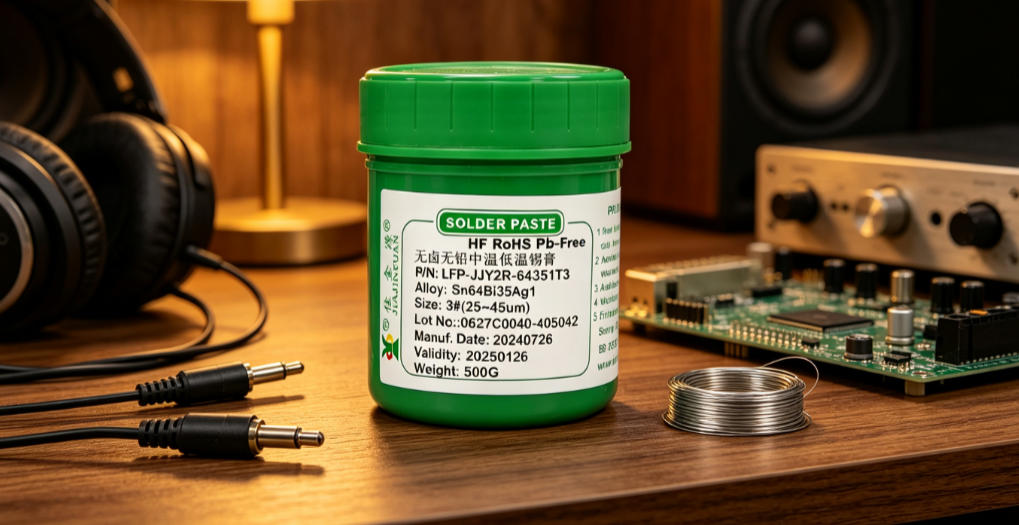
When changing solder paste brands during SMT production, a strict SMT verification process must be implemented, covering multi-dimensional tests such as printability, mountability, reflow performance, and solder joint reliability. The focus is on monitoring changes in solder paste viscosity, stencil life attenuation, and the incidence of solder balls and bridging, to avoid batch cold solder joints or tombstoning defects caused by batch switching.
Published: 2015-08-09Rework soldering is a critical process in PCBA repair that demands extremely high precision and thermal control. This paper focuses on the full process of desoldering and replacing chips such as BGA and QFN, covering hot air gun parameter setting, stencil aperture matching, solder paste selection, and key points of post-soldering X-ray inspection. All parameters are derived from measured data on the JJY production line, emphasizing the coordinated control of temperature curve gradients, nozzle vacuum values, and PCB delamination risks.
Published: 2015-07-12The standard for repeated refrigeration, thawing and reuse of solder paste and the scrap judgment are directly related to the yield and cost of SMT production lines. Based on 20 years of measured production line data from JJY, this paper clarifies that under the refrigeration condition of 4±2℃, solder paste is allowed to be reused for no more than 3 times after thawing, the effective service time after each thawing is 24 hours, and the solder paste will be scrapped when it is exposed to room temperature for more than 72 hours in total. It also points out that the solder paste must be stopped immediately when the viscosity rebound exceeds 15%, the metal content drops by more than 0.8%, or the flux stratification is obvious.
Published: 2015-06-26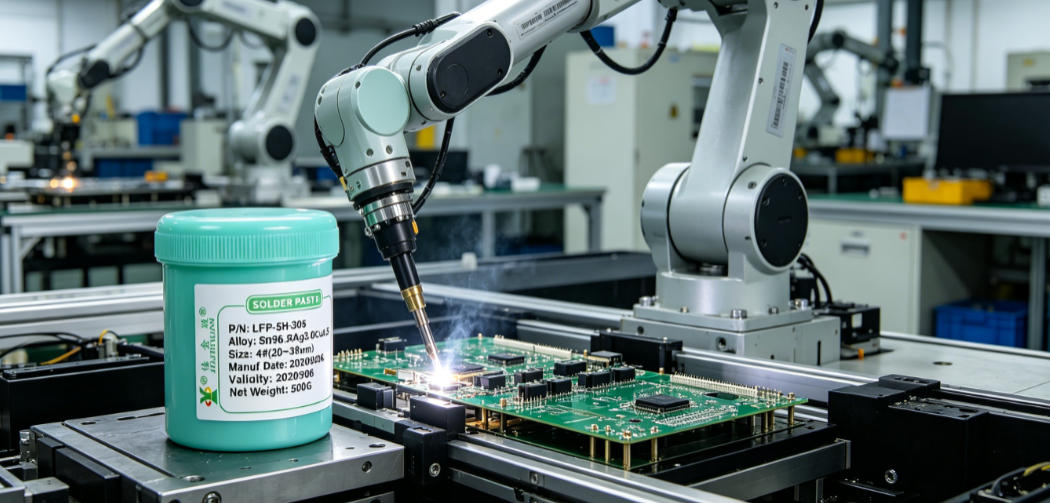
SMT solder paste must be stored refrigerated to inhibit oxidation of the metal powder and chemical reactions of the flux, preventing increased viscosity, aggravated slump, and reduced printing accuracy. The warm-up procedure must strictly follow the process of 4 hours of standing at room temperature followed by 2 hours of stirring, to avoid splashing and cold solder joints caused by condensation water contamination. This is a critical step that production line engineers must not skip before starting work each day.
Published: 2015-06-05Fluctuations in the alloy composition of solder paste directly undermine its soldering stability, causing batch defects such as cold solder joints, bridging, and poor wetting. Especially in high-density placement scenarios like 0201 components and 0.4mm pitch QFN packages, even a ±0.05wt% deviation in the tin-silver-copper ratio of the alloy solder paste can lead to a drop of over 12% in post-reflow solder joint thrust. Therefore, continuous monitoring of solder paste quality is a critical line of defense to ensure the SMT first-pass yield.
Published: 2015-05-21The production of export wiring harness connectors must comply with the RoHS lead-free regulations, and connector solder must adopt compliant ratios such as Sn96.5/Ag3.0/Cu0.5. Jiajinyuan solder has stable wettability at a peak temperature of 245℃, and is compatible with terminal crimping and reflow soldering of multiple specifications with wire diameters ranging from 0.13 to 2.5mm. In mass production, the defect rates of solder balls, cold soldering, insufficient solder climbing and other defects are controlled within 800ppm.
Published: 2015-05-10Soldering of 01005 components is extremely sensitive to solder paste volume control, and the stencil thickness directly determines the solder paste printing volume. Jia Jinyuan's actual measurements show that a 0.1mm stencil can stably control the solder paste volume within the range of 120±15μm in 01005 component soldering. Excessive thickness easily leads to tombstoning and bridging, while insufficient thickness causes cold soldering and solder balls. Collaborative optimization combining aperture size and squeegee pressure is the key to production line implementation.
Published: 2015-04-21Our technical team is always ready to provide professional solder material selection advice and SMT process solutions.