SMT Solder Paste Manufacturers.

Focused on SMT soldering processes, a one-stop electronic soldering solutions provider.

Here you can find knowledge about Industrial Control Board Solder, including but not limited to usage methods, installation techniques, troubleshooting and more. Focused on SMT soldering processes. If you can't find what you need, please contact us anytime.
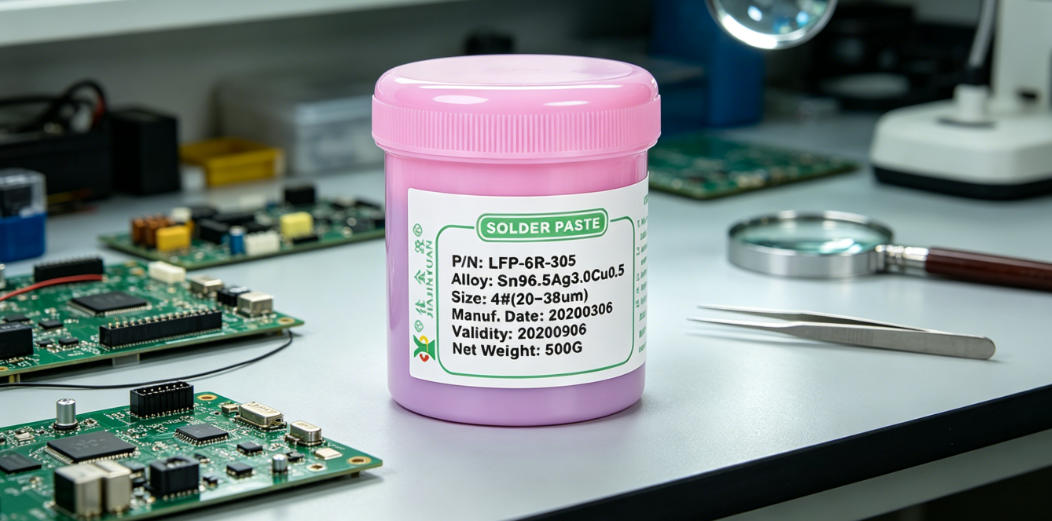
SMT soldering of industrial control boards is highly sensitive to the technical specifications of solder paste. Since industrial control boards generally feature large-area copper foils, multilayer thick boards, high-TG substrates, and fine-pitch components such as BGA/CSP, defects including printing slump, reflow voids, and poor wetting occur frequently. Viscosity, metal content, particle size distribution, flux activity, and residue insulation in the technical specifications of solder paste directly determine the first-pass yield and long-term reliability.
Published: 2026-08-27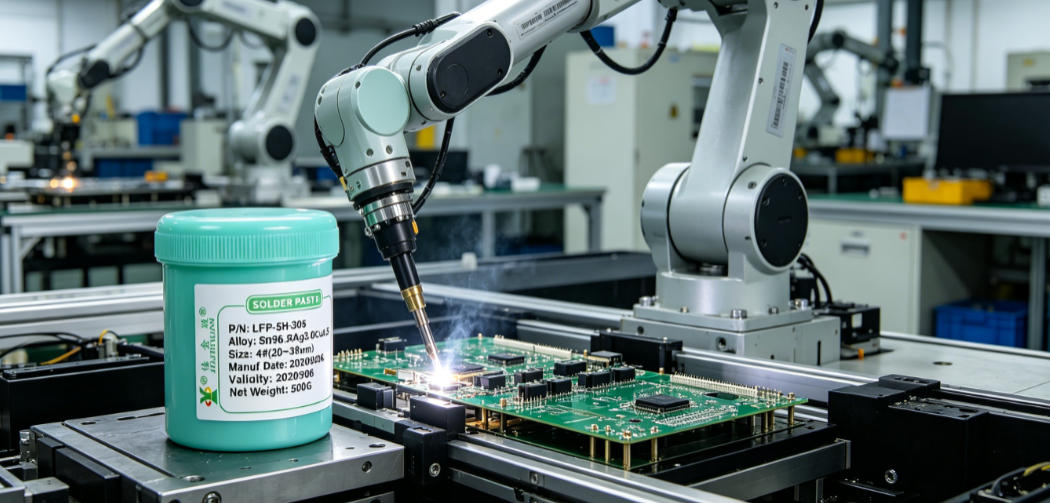
SMT for automotive industrial control boards has extremely high requirements for soldering reliability; even minor deviations in solder paste control can trigger batch defects such as cold solder joints, solder bridges, and tombstoning. This article directly addresses real-world misconceptions on the production line, covering five high-incidence issues: temperature control failure during solder paste storage, insufficient reflow time, mismatched squeegee pressure, mismatch between stencil aperture design and solder paste particle size, and excessive dwell time after printing. Each point is derived from measured failure cases, emphasizing that solder paste control in industrial control board SMT must run through the entire process from material requisition to component placement.
Published: 2026-08-27
The Chinese SMT solder market is undergoing structural adjustment, with accelerated domestic substitution and products moving toward high-end development.
Published: 2026-08-24
The global solder industry is accelerating its transition toward environmental friendliness and high-end products, with lead-free and halogen-free solder becoming the mainstream.
Published: 2026-08-24
The industrial control industry includes core automation equipment such as PLCs, industrial robots, servo drives, and inverters. The equipment operates in environments with high-frequency vibration, temperature fluctuations, and high loads for extended periods, imposing stringent requirements on welding reliability.
Published: 2026-08-24By subjecting industrial control motherboard solder samples to combined accelerated aging, temperature cycling, and vibration stress tests, we realistically simulate a decade of service environment on the production line, focusing on the microcrack propagation rate of solder joints, changes in IMC layer thickness, and shear force attenuation trends, to provide reproducible failure boundary data for JJY's industrial control motherboard solder selection and reflow parameter optimization.
Published: 2025-11-25
In 2023, the solder paste market showed a diversified development trend, with traditional industrial applications continuing to integrate with emerging fields such as new energy and semiconductors. The driving factors include technological progress, industrial transformation, and policy support. Industry practitioners need to pay attention to changes in market demand and optimize product structure.
Published: 2024-02-08The solder for industrial control motherboards must maintain zero solder joint cracking under wide temperature range, high vibration and long-cycle operating conditions. Jiayuan's high-reliability halogen-free formula, by optimizing the SnAgCu alloy ratio and active flux system, keeps the IMC layer thickness stably at 3.2±0.4μm after 500 cycles of thermal shock from -40℃ to 85℃, completely avoids electromigration failure caused by halogen corrosion, and significantly improves the service life of industrial control motherboard solder in harsh scenarios such as rail transit and power monitoring.
Published: 2020-07-01The solder for industrial control motherboards is specifically designed for high-reliability soldering of industrial control motherboard PCBA. It features excellent wettability, low void rate, and strong thermal cycle resistance, meeting the demands of harsh scenarios such as wide temperature range, long service life, and vibration resistance. It is a core material for ensuring the long-term stability of solder joints on industrial control motherboards.
Published: 2017-06-01Jiajinyuan PCBA soldering materials are specifically designed for new energy battery management system BMS boards, photovoltaic inverter control boards, and industrial PLC main control boards. Its low-void-rate solder paste maintains a stable void area of less than 12% after reflow in 0.3mm fine-pitch QFN packages, which can be further reduced to 8.5% with a nitrogen atmosphere, meeting the stringent requirements of automotive-grade AEC-Q200 for solder joint reliability.
Published: 2016-12-27Our technical team is always ready to provide professional solder material selection advice and SMT process solutions.