SMT Solder Paste Manufacturers.

Focused on SMT soldering processes, a one-stop electronic soldering solutions provider.

Here you can find knowledge about Solder Ball Reduction, including but not limited to usage methods, installation techniques, troubleshooting and more. Focused on SMT soldering processes. If you can't find what you need, please contact us anytime.
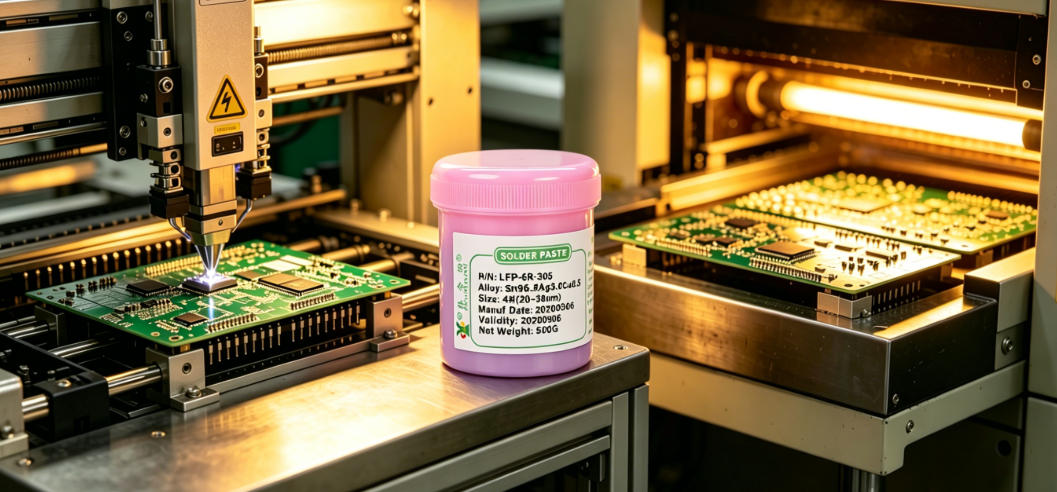
Dull solder joints after solder paste soldering are often not caused by a single factor, but rather the combined effect of multiple process variables such as insufficient solder paste activity, mismatched reflow temperature profile, unreasonable stencil aperture design, low nitrogen purity, or oxidation of PCB pads. Among these, the metal content of the solder paste itself and the flux system have the most direct impact on the final solder joint gloss.
Published: 2025-10-06Unstable soldering quality of OSP boards often stems from a mismatch between the activity of solder paste flux and the chemical stability of the OSP film, leading to poor wetting, cold solder joints, or blackened solder joints. Jiajinyuan series solder paste precisely removes the OSP film without corroding the copper surface through a gradient activity design, and its controllable stripping capability for 0.3μm thick OSP film has been verified on multiple production lines.
Published: 2025-09-27In the SMT soldering production line, solder paste thawing and stirring operations directly affect printing yield and reflow soldering void rate. Jia Jinyuan solder paste must be left to stand in an environment of 22℃±2℃ for more than 4 hours to be fully thawed. Stirring must adopt a dual-parameter locked mode with a constant speed of 60rpm and a duration of 120 seconds; otherwise, defects such as solder balls, solder spikes, and solder paste collapse are likely to occur.
Published: 2025-09-10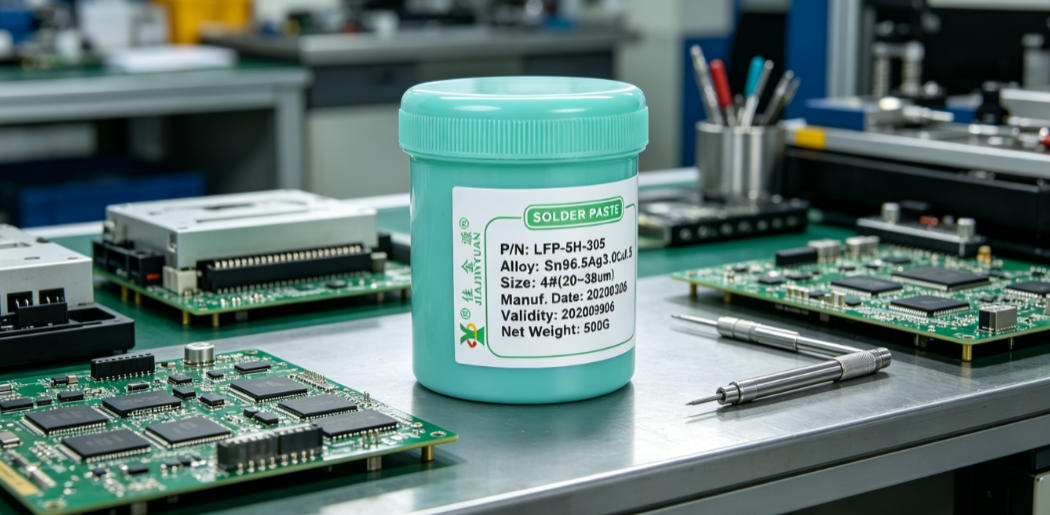
Low-temperature solder paste is suitable for heat-sensitive components such as MLCCs, LED beads, flexible printed circuits, and connectors with plastic housings. Its melting point is typically 138°C to 170°C, more than 50°C lower than that of traditional solder paste, which can significantly reduce the risk of thermal stress damage, while imposing higher requirements for reflow soldering zone settings and nitrogen protection.
Published: 2025-08-20High-oxidation-resistance solder bars suppress the continuous generation of solder dross at the source by improving the stability of the surface tension of molten solder and the compactness of the oxide film. Under the measured condition of 8 hours of continuous wave soldering operation, the solder dross output can be reduced by 42% to 58%, significantly extending the maintenance cycle of the solder pot and reducing the frequency of manual dross removal.
Published: 2025-08-18To address the frequent occurrence of bridging defects in the SMT process, we optimized the matching of stencil aperture size and thickness, adjusted the collaborative parameters of squeegee pressure and speed, and selected Jia Jinyuan anti-rheology solder paste to reduce the tendency of post-printing slump. This significantly reduced bridging caused by solder overflow on fine-pitch components such as 0402 and 0603, and improved the first article pass rate and first-pass yield.
Published: 2025-08-01Insufficient solder occurs frequently on SMT production lines, with root causes concentrated in stencil clogging and poor solder paste transfer rate, which often reinforce each other. For example, residual dried solder paste film around stencil apertures further reduces the solder paste transfer rate in subsequent printing, while a low transfer rate in turn exacerbates the batch occurrence of insufficient solder defects. The actual performance of Jia Jinyuan solder paste under different stencil thicknesses and aperture ratios has verified this pattern.
Published: 2025-07-17Reflow soldering is a key step in the SMT placement process to achieve metallurgical bonding of component pads. Solder paste goes through four stages in the reflow oven: preheating, soaking, reflow, and cooling, to complete melting and wetting. Its temperature profile setting, furnace temperature uniformity, and solder paste activity directly affect solder joint strength and void rate.
Published: 2025-07-04The solder sample testing focuses on measured furnace temperature profile data and stencil aperture parameter adjustments. By comparing the differences in printing accuracy, reflow wettability, and cold solder joint rate between old and new Jia Jinyuan solders, the process adaptability of the new solder in 0201 components and fine-pitch QFN packages is verified, providing a reproducible parameter baseline for mass production switching.
Published: 2025-06-18PCBA reliability testing is a key method for verifying finished product solder joints in real service environments. Through three types of rigorous tests—temperature cycling resistance, random vibration, and damp heat aging—it exposes hidden defects such as cold solder joints, dry solder joints, and abnormal growth of interfacial intermetallic compounds. In particular, it provides data support for solder joint failure modes of high-density packages such as BGA and QFN, offering a direct basis for JJY's production line process optimization and customer delivery risk control.
Published: 2025-06-13Our technical team is always ready to provide professional solder material selection advice and SMT process solutions.